The BEASTARS study: 3-year outcomes of DES vs DCB for FPA disease
Selected in JACC: Cardiovascular Interventions by Miléna Usui
Endovascular management of femoropopliteal artery (FAP) disease increasingly relies on drug-based technologies, yet the optimal strategy after successful lesion preparation remains debated.
The BEASTARS study compares 3-year outcomes of drug-eluting stents (DES) and drug-coated balloons (DCB), focusing on whether improved patency translates into meaningful clinical benefit in real-world practice.
References:
Authors: Tatsuya Nakama, Mitsuyoshi Takahara, Yo Iwata, Kenji Suzuki, Kazuki Tobita, Naoki Hayakawa, Kazunori Horie, Shunsuke Mori, Kotaro Obunai, and Takao Ohki
Reference: JACC: Cardiovascular Interventions - Volume 18, Number 17 - 8 September 2025
DOI: doi/abs/10.1016/j.jcin.2025.07.034
Read the abstractObjective:
The aim of this study was to compare 3-year outcomes of DES vs DCB without bailout stenting in symptomatic FPA disease after successful lesion preparation.
Study:
Retrospective study from a multicenter registry between 2017 and 2021 who underwent endovascular therapy for FPA using DES (n = 342) or DCB (n = 1,064) after successful lesion preparation.
Population:
1,406 patients with symptomatic atherosclerotic FPA disease (Rutherford 2-5) from 7 Japanese cardiovascular centers.
Endpoints:
- Primary endpoint was primary patency and freedom from clinically driven target lesion revascularisation (CD-TLR)
- Secondary endpoints were limb salvage, overall survival ,and freedom from acute index limb ischemia
Outcomes:
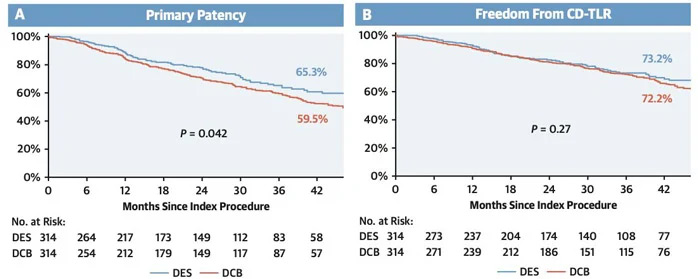
Over 3 years, DES demonstrated a significantly higher primary patency compared with DCB (65.3 % vs 59.5 %, P = 0.042).
However, freedom from clinically driven target lesion revascularisation (CD-TLR) was similar between the two groups (73.2 % vs 72.2 %, P = 0.27), indicating that the improved patency of DES did not translate into a clear clinical benefit in terms of reintervention.

Get the latest clinical cases and breaking news delivered straight to your inbox!

Conclusion:
Despite successful lesion preparation, DES demonstrated significantly higher primary patency over 3 years.
However, this did not translate into a clinical benefit, as freedom from CD-TLR rates remained comparable between groups.