Revision of below-knee amputation stumps to a higher level in patients with peripheral vascular disease
Selected in Journal of Vascular Surgery by Cédric Lacoste
Below-knee amputation (BKA) remains a frequent outcome in patients with advanced peripheral arterial disease (PAD), particularly in the setting of chronic limb-threatening ischemia and uncontrolled infection.
Despite careful patient selection, stump failure requiring revision to a higher-level amputation remains common and carries significant clinical and economic consequences.
This retrospective single-center study evaluates clinical and anatomical factors associated with BKA failure, with a specific focus on identifying predictors of stump healing and reducing the need for revision surgery.
References:
Authors:
Mina Abdelmalak, Louise M. Finch, Haydn Richards, Mark Tawadrous, and Ragai Makar
Reference: Published online October 27, 2025
DOI: DOI: 10.1016/j.jvs.2025.10.026
Read the abstractObjective:
The aim of this study is to evaluate clinical and anatomical factor associated with failure of below-knee amputation.
The objective is then to identify predictors of stump healing and reducing the need of re-operation.
Study:
The study is a retrospective single-center cohort.
Population:
All patients who underwent below-knee amputation between April 2014 and October 2021 for peripheral vascular disease were included.
Other etiologies such as burns, trauma or malignancy were excluded.
Outcomes:
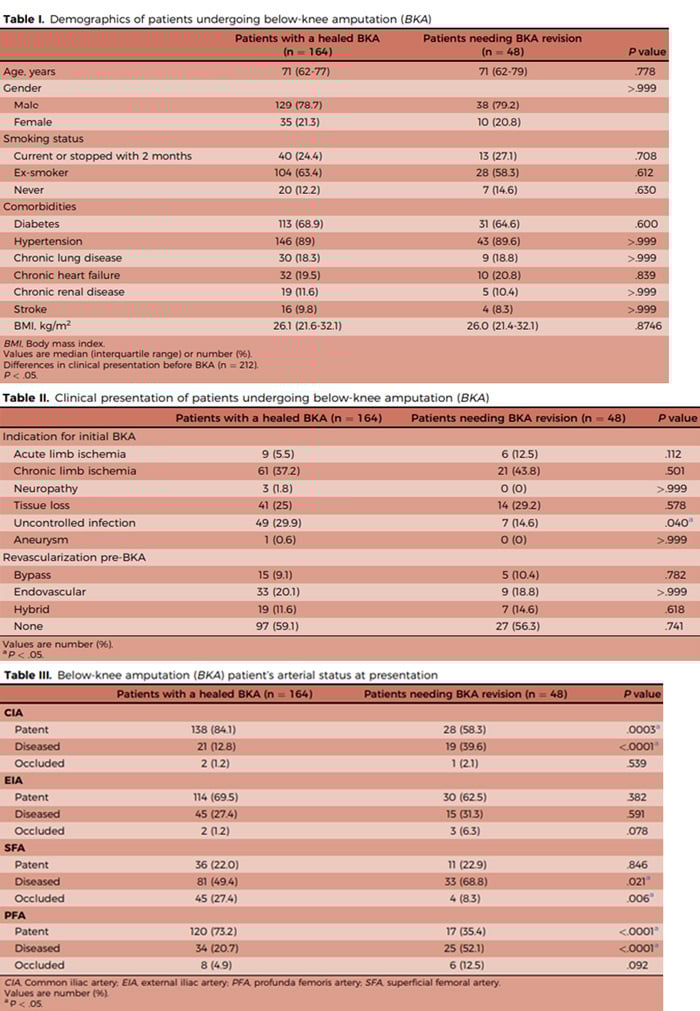
212 patients underwent a below-knee amputation, among them 48 patients (22.6 %) required a revision surgery.
No significant differences in comorbidities, smoking status and revascularisation procedure were founded.
- Predictors of re-operation found: diseased profunda femoris and common iliac artery.
- Predictors of stump healing found : patent profunda femoris and common iliac artery and unexpectedly, superficial artery occlusion and initial indication for uncontrolled infection.
- Length of stay increased in patient requiring a re-operation with an average additional cost of £3105 per patient.

Get the latest clinical cases and breaking news delivered straight to your inbox!

Conclusion:
Aproximately one in four patient required a revision, which represents a high rate of revision with significant costs.
The patency of the profunda femoris emerged as the strongest predictor of stump healing.
Discussion :
The study has a low level of scientific evidence due to a patient sample that is too small and a weak methodology.