When drugs are not the solution: resistant hypertension calls for more
Renal artery aneurysms are uncommon, and their management depends on more than aneurysm size alone. Current guidelines recommend intervention in selected patients, including those with refractory hypertension or specific clinical and anatomical risk factors.
A 27-year-old woman with neurofibromatosis type 1 and severe hypertension despite four antihypertensive drugs was found to have a 22-mm post-stenotic renal artery aneurysm.
With complex anatomy and a clinical picture that remained uncontrolled despite medical treatment, the key question was not simply whether to treat, but how.

Introduction
Renal artery and branch aneurysms are uncommon, with a reported prevalence of 0.01%–1% in the general population. They occur more frequently in women and may be associated with conditions such as neurofibromatosis, atherosclerosis, trauma or mycotic infection. Although rare, rupture remains their main complication.
Current ESVS guidelines recommend considering repair of asymptomatic renal artery aneurysms ≥ 30 mm, while SVS guidelines also recommend treatment in women of childbearing age and in patients with refractory hypertension.
The choice between an endovascular or open approach depends on the patient’s clinical profile, aneurysm anatomy and the expertise of the treating team.
Case presentation
- The patient was a 27-year-old woman, a non-smoker, with uncontrolled hypertension despite treatment with four antihypertensive drugs.
- She had type 1 neurofibromatosis and was a Jehovah’s Witness.
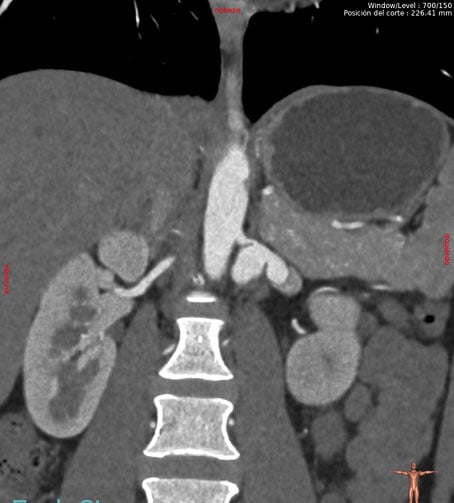
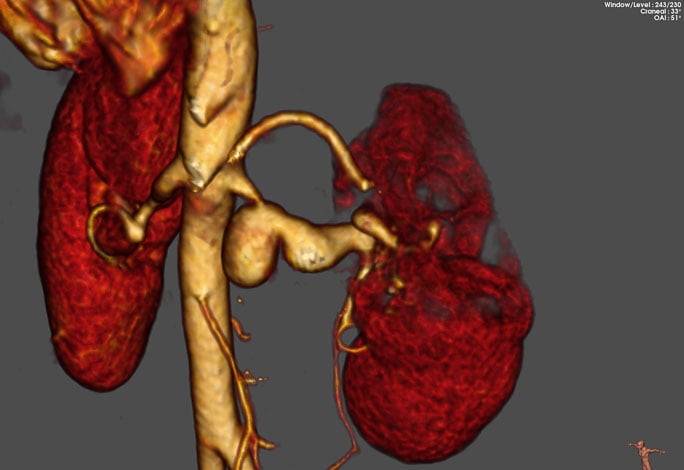
- CT angiography, performed as part of the investigation of her persistent hypertension, revealed an aneurysm of the left renal artery associated with a stenosis approximately 1 cm from its origin.
- The reconstructions showed a post-stenotic aneurysm measuring 22 mm at its maximum diameter, with a distal neck measuring 4–5 mm in length and a distal renal artery measuring 10 mm in diameter.
- Coronal slices and 3D reconstruction demonstrated the complex morphology of the aneurysm.
Get the latest clinical cases and breaking news delivered straight to your inbox!
