Anticoagulation in advanced CKD: a risky balance
Selected in JAMA by Manon Marchand
Advanced chronic kidney disease (CKD) is associated with a particularly challenging balance between cardiovascular and bleeding risks. Yet patients with stage 4–5 CKD, especially those on dialysis, have been largely excluded from major trials of antithrombotic therapy.
The TRACK trial investigated whether low-dose rivaroxaban could reduce cardiovascular events in this high-risk population. Its findings provide important new data on the potential role—and limitations—of anticoagulation in advanced CKD.
References:
Authors: Sunil V. Badve, Vlado Perkovic, Vivekanand Jha, et al.
Reference: Published Online: June 4, 2026 - 2026;336;(4):296-305
DOI: 10.1001/jama.2026.9379
Read the abstractRationale & clinical context:
Patients with stage 4–5 CKD (eGFR < 30 mL/min) have a high cardiovascular risk, with 10–15% annual cardiovascular event rates, but also a major bleeding risk (5–7% annually). These patients have largely been excluded from major anticoagulation trials.
While low-dose rivaroxaban plus aspirin reduced cardiovascular events by 15–24% in patients with mild-to-moderate CKD in COMPASS and VOYAGER PAD, its benefit–risk profile in advanced CKD remains unknown.
Objective:
To determine whether low-dose rivaroxaban (2.5 mg twice daily) reduces major cardiovascular events compared with placebo in patients with advanced CKD (stage 4–5), including those on dialysis.
Study:
TRACK was a randomised, placebo-controlled trial conducted across 90 centres in 12 countries between January 2021 and July 2025.
Patients were randomised 1:1 to rivaroxaban 2.5 mg twice daily or placebo, following a 21-day placebo run-in period.
The trial was stopped early for futility on 7 August 2025, after an interim analysis showed a very low probability of demonstrating the expected cardiovascular benefit, alongside an unfavourable bleeding signal.
Population:
Adults with stage 4–5 CKD (eGFR ≤ 29 mL/min/1.73 m²), either not on dialysis or dialysis-dependent, were eligible if they had at least one cardiovascular risk factor.
Key exclusion criteria included current anticoagulation, high bleeding risk, LVEF < 30%, haemorrhagic or lacunar stroke, mechanical heart valves, and relevant drug interactions.
Endpoints:
The primary efficacy endpoint was a composite of cardiovascular death, non-fatal myocardial infarction, non-fatal stroke, and non-fatal PAD events.
Secondary endpoints included all-cause mortality and venous thromboembolism, while tertiary endpoints assessed dialysis access thrombosis, quality of life, and cost-effectiveness.
The main safety endpoint was major bleeding, defined as fatal bleeding, symptomatic bleeding in a critical organ, bleeding requiring surgery, or bleeding resulting in hospitalisation.
Outcomes:
At a median follow-up of 1.7 years, rivaroxaban did not reduce the primary cardiovascular endpoint compared with placebo (22.6% vs 20.7%; HR 1.09, 95% CI 0.87–1.36; p = 0.46), with no significant differences across pre-specified subgroups.
There was also no significant benefit for all-cause mortality or dialysis access thrombosis. Venous thromboembolism was the only endpoint significantly reduced with rivaroxaban (0.6% vs 1.9%; HR 0.29, 95% CI 0.09–0.87). Quality-of-life and cost-effectiveness data are still being collected.
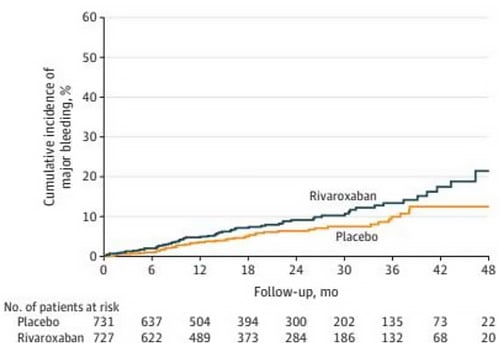
Importantly, major bleeding was significantly increased with rivaroxaban (8.8% vs 6.0%; HR 1.51, 95% CI 1.02–2.22; p = 0.04), with a particularly marked increase among patients aged ≥ 65 years.

Get the latest clinical cases and breaking news delivered straight to your inbox!

Why did TRACK differ from COMPASS and VOYAGER PAD?
Unlike COMPASS and VOYAGER PAD, which showed a cardiovascular benefit with low-dose rivaroxaban added to aspirin in patients with established atherosclerotic disease, TRACK tested rivaroxaban alone in patients with advanced CKD.
The specific pathophysiology of advanced CKD and the high proportion of sudden cardiac deaths (42.1%) may also help explain the absence of cardiovascular benefit.
Limitations and discussion:
TRACK is notable for studying a largely understudied population of patients with stage 4–5 CKD, including those on dialysis, using robust, double-blind, multicentre methodology with independent blinded adjudication.
However, the trial was stopped early for futility, limiting its statistical power and the precision of the estimates. The 28% treatment discontinuation rate may also have reduced the ability to detect a treatment effect.
Generalisability is limited by the absence of US and Black populations. Finally, the findings cannot be extrapolated to rivaroxaban combined with aspirin, and data on minor bleeding were not available.
Conclusion
In patients with advanced CKD, low-dose rivaroxaban alone did not reduce cardiovascular events but significantly increased major bleeding, particularly in patients aged ≥ 65 years.
These findings cannot be extrapolated to the rivaroxaban–aspirin combination, but they highlight the need for dedicated trials to guide antithrombotic strategies in this high-risk population.