Global trends in major lower limb amputation
Selected in ESVS Journal by Lubin Alonzo
Major lower limb amputation remains one of the most severe outcomes of peripheral arterial disease and diabetes, reflecting both disease progression and limitations in limb salvage strategies.
This systematic review and meta-analysis explores global temporal trends in amputation incidence, highlighting marked differences between high-income and low- and middle-income countries despite overall advances in vascular and diabetic foot care.
References:
Authors: Nick Moody, Leanne Murphy, Becky Sandford, Rhiannon Nielsen, Megan Lyons, Amy Walter, David C. Bosanquet, Kathryn Chu, Matthew Popplewell, Justine Davies
Reference: Published online April 24, 2026
DOI: DOI: 10.1016/j.ejvs.2026.04.028
Read the abstractRationale & clinical context
Major lower limb amputations (above the ankle) remain catastrophic outcomes associated with significant morbidity and mortality.
While the global prevalence of cardiovascular risk factors such as peripheral arterial disease and diabetes continues to rise, advances in revascularisation techniques and diabetic foot management have improved limb salvage strategies.
Against this background, understanding temporal trends in amputation incidence is essential.
Objective:
This systematic review and meta-analysis aimed to evaluate global temporal trends in the incidence of major lower limb amputations using population-level data published since 2008.
Study:
This was a systematic review and meta-analysis of the literature published since 2008, conducted using Medline, Embase, Scopus, and African Journals Online databases.
The review included population-based studies reporting temporal trends in major lower limb amputation incidence over at least two time points.
Population:
Studies were included if they reported population-level incidence of major lower limb amputations in either the general population or at-risk populations (peripheral arterial disease or diabetes). Eligible studies had to provide denominator-based incidence data over time.
Studies without clear population denominators, those reporting only absolute numbers, highly selected subgroups (e.g. dialysis patients), or war-related trauma cohorts were excluded.
Endpoints:
The primary endpoint was the temporal trend in incidence of major lower limb amputation, defined as any amputation at or above the level of the ankle (including Chopart-level procedures).
Etiologies included peripheral arterial disease, diabetes, trauma, and other causes.
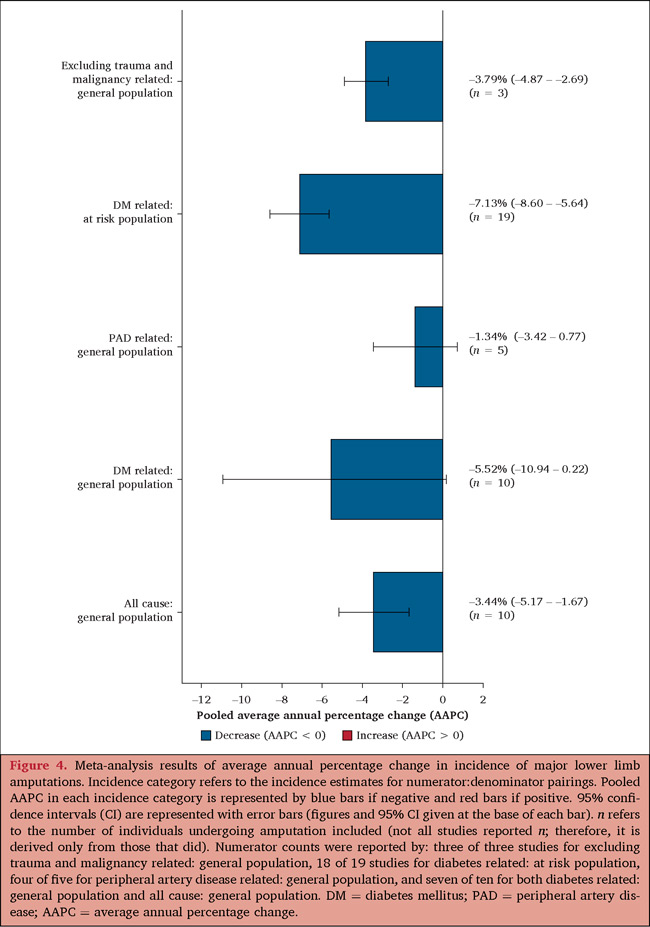
Trends were quantified using average annual percentage change (AAPC) derived from population-based incidence estimates.
Outcomes:
Incidence rates were standardised per 100,000 individuals and temporal trends assessed using average annual percentage change (AAPC), with only studies reporting ≥ 3 consecutive years included in the meta-analysis.
A significant decline in major lower limb amputations was observed in high-income countries, including a -3.44% annual decrease in the general population and a -7.13% decrease in diabetes-related amputations in at-risk populations.
In contrast, available data from low- and middle-income countries showed increasing amputation rates, highlighting a marked global disparity.

Get the latest clinical cases and breaking news delivered straight to your inbox!

Limitations:
The analysis is limited by significant heterogeneity between studies and variability in the definition of major amputation, with some including or excluding mid-foot procedures. The retrospective nature of the included data introduces potential coding bias.
In addition, important geographical gaps exist, particularly from the Middle East, South Asia, and North Africa, with most cohorts derived from high-income countries, potentially limiting the global representativeness of the findings.
Conclusion
This study highlights an overall decline in major lower limb amputation rates in high-income countries, likely reflecting improved risk factor management and advances in revascularisation strategies.
In contrast, amputation incidence appears to be rising in low- and middle-income countries, underscoring a growing global disparity.
These findings reinforce the need for better standardisation of definitions and coding practices, as well as improved global data collection to accurately monitor and address this burden.