LIFE-BTK at 3 years: does the benefit last?
Selected in JACC by Thomas Montassier
In patients with chronic limb-threatening ischemia (CLTI), infrapopliteal disease remains challenging to treat, with restenosis potentially compromising the durability of revascularisation. While balloon angioplasty (PTA) remains a standard approach, drug-eluting resorbable scaffolds (DRS) combine temporary vessel support with local everolimus delivery, before being fully resorbed.
The LIFE-BTK trial previously demonstrated superior 1-year efficacy of DRS over PTA. But as the scaffold progressively disappears, an important question remains: does its clinical benefit persist beyond resorption?
This 3-year analysis provides longer-term data on the efficacy and safety of DRS compared with PTA in patients with infrapopliteal CLTI.
References:
Authors: Sahil A. Parikh, Brian G. DeRubertis, Marc P. Bonaca, Prakash Krishnan, Richard H. Pin, Jen-Kuang Lee, David C. Metzger, Raghu Kolluri, Mehdi H. Shishehbor, Andrew H. Holden, Osamu Iida, Ehrin Armstrong, Steven W.C. Kum, David J. O’Connor, Danielle R. Bajakian, Lawrence A. Garcia, Shih-Wa Ying, Jin Wang, Karine Ruster, Brad J. Martinsen, Zsuzsanna Igyarto, and Ramon L. Varcoe
Reference: JACC Volume 88, Number 1 - 13 May 2026
DOI: DOI: 10.1016/j.jacc.2026.04.008
Read the abstract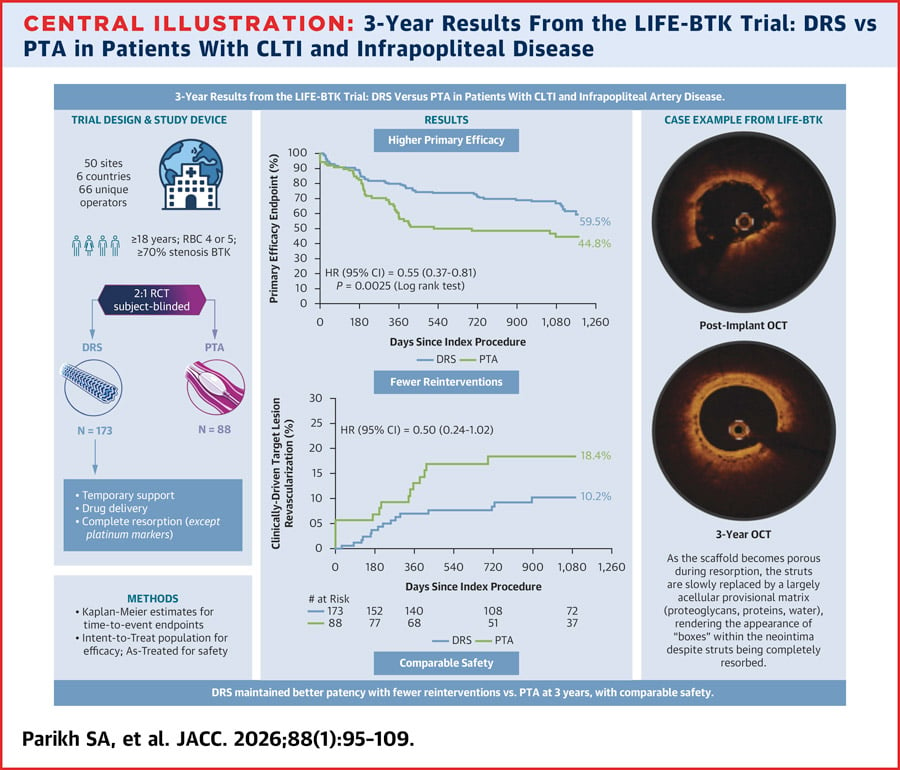
Context
Chronic limb-threatening ischemia (CLTI) carries a high risk of amputation and mortality, making effective limb revascularisation essential.
For infrapopliteal disease, plain balloon angioplasty (PTA) remains widely used but is limited by restenosis and other vessel-related complications.
The drug-eluting resorbable scaffold (DRS) offers a different approach: temporary mechanical support and local everolimus delivery, followed by complete scaffold resorption.
Objective:
To compare the 3-year efficacy and safety of a drug-eluting resorbable scaffold (DRS) versus balloon angioplasty (PTA) in patients with chronic limb-threatening ischemia (CLTI) and infrapopliteal artery disease.
Study:
LIFE-BTK was a prospective, multicentre, randomised controlled trial, conducted in 50 sites across 6 countries with 66 operators.
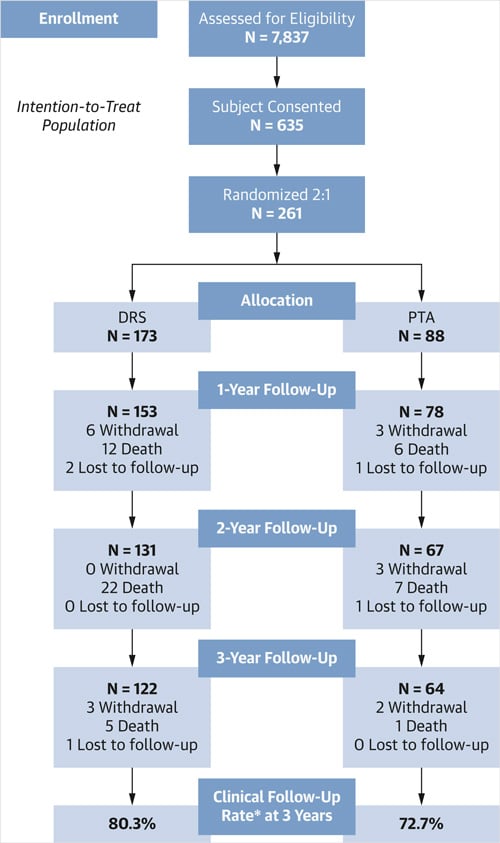
Between July 2020 and September 2022, 261 patients with CLTI and infrapopliteal artery disease were randomised 2:1 to receive a drug-eluting resorbable scaffold (DRS; n = 173) or balloon angioplasty (PTA; n = 88).
Patients were followed at 30 days, 3 months, 6 months, 1 year, and annually thereafter, up to 5 years. The present analysis reports the 3-year outcomes.
Population:
The trial enrolled adults with chronic limb-threatening ischemia (CLTI) classified as Rutherford-Becker 4 or 5, with infrapopliteal artery disease defined by:
≥ 70% stenosis or occlusion in the proximal two-thirds of an infrapopliteal artery
At least one patent runoff vessel to the ankle
Patients with acute limb ischemia, a contraindication to dual antiplatelet therapy, or planned atherectomy or specialised balloon treatment of the target lesion(s) were excluded.
Outcomes:
The primary efficacy endpoint was a composite of primary patency and limb salvage, including freedom from above-ankle amputation of the target limb, total target-vessel occlusion, clinically driven target lesion revascularisation (CD-TLR), and binary restenosis of the target lesion.
At 3 years, the primary efficacy endpoint was achieved in 59.5% of patients in the DRS group versus 44.8% in the PTA group (HR 0.55; 95% CI 0.37–0.81; P = 0.0025). Binary restenosis occurred in 38.0% versus 49.0%, respectively (HR 0.60; 95% CI 0.40–0.92).
The primary safety endpoint was freedom from major adverse limb events (MALE) at 3 years and perioperative death at 30 days. At 3 years, this endpoint was achieved in 90.8% of the DRS group and 94.2% of the PTA group (HR 1.94; 95% CI 0.64–5.89; P = NS).
Limb salvage was achieved in 93.8% versus 95.7% (HR 1.59; 95% CI 0.43–5.89; P = NS), while CD-TLR occurred in 10.2% versus 18.4% (HR 0.50; 95% CI 0.24–1.02; P = NS) in the DRS and PTA groups, respectively.

Get the latest clinical cases and breaking news delivered straight to your inbox!

Discussion
The 3-year results suggest that the benefit of the resorbable scaffold on vessel patency persists beyond scaffold resorption, with lower restenosis and fewer repeat interventions than PTA. The absolute difference in the primary efficacy endpoint narrowed over time, from +30.8% at 1 year to +23.3% at 3 years, but remained statistically significant in favour of DRS. The authors propose that progressive scaffold resorption and the natural selection of patients who remain event-free in the PTA group may contribute to this attenuation.
The findings are consistent with previous trials evaluating drug-eluting technologies in BTK disease and provide randomized evidence supporting the concept of temporary mechanical support combined with local everolimus delivery.
However, the 3-year results should be interpreted cautiously. Only 57% of patients completed the full follow-up, and the trial included a highly selected population with relatively short lesions and favourable anatomy. The subgroup analyses were exploratory and should therefore be considered hypothesis-generating rather than definitive.
The slides also highlight an important clinical point: the apparent benefit was more pronounced in Rutherford 4, in the absence of significant proximal disease, and in lesions with absent or mild calcification. Conversely, uncertainty remains for very long or heavily calcified lesions.
Conclusion
At 3 years, the everolimus-eluting resorbable scaffold maintained a significant advantage over balloon angioplasty in vessel patency, with lower restenosis and fewer reinterventions, while safety and limb salvage remained comparable between groups.
The findings support the DRS as a targeted treatment option for selected patients with infrapopliteal CLTI rather than as a systematic replacement for PTA. Longer-term and real-world data are still needed to clarify its durability, optimal indications and cost-effectiveness.