Paclitaxel-coated devices in intermittent claudication: an update from the 2024 ESVS Guidelines
Selected in ESVS Journal by Thomas MONTASSIER
Paclitaxel-coated balloons and drug-eluting stents have consistently reduced restenosis and repeat revascularisation after femoropopliteal interventions.
However, concerns about a potential increase in long-term mortality, first raised by the 2018 meta-analysis by Katsanos et al., have fueled ongoing debate despite subsequent analyses.
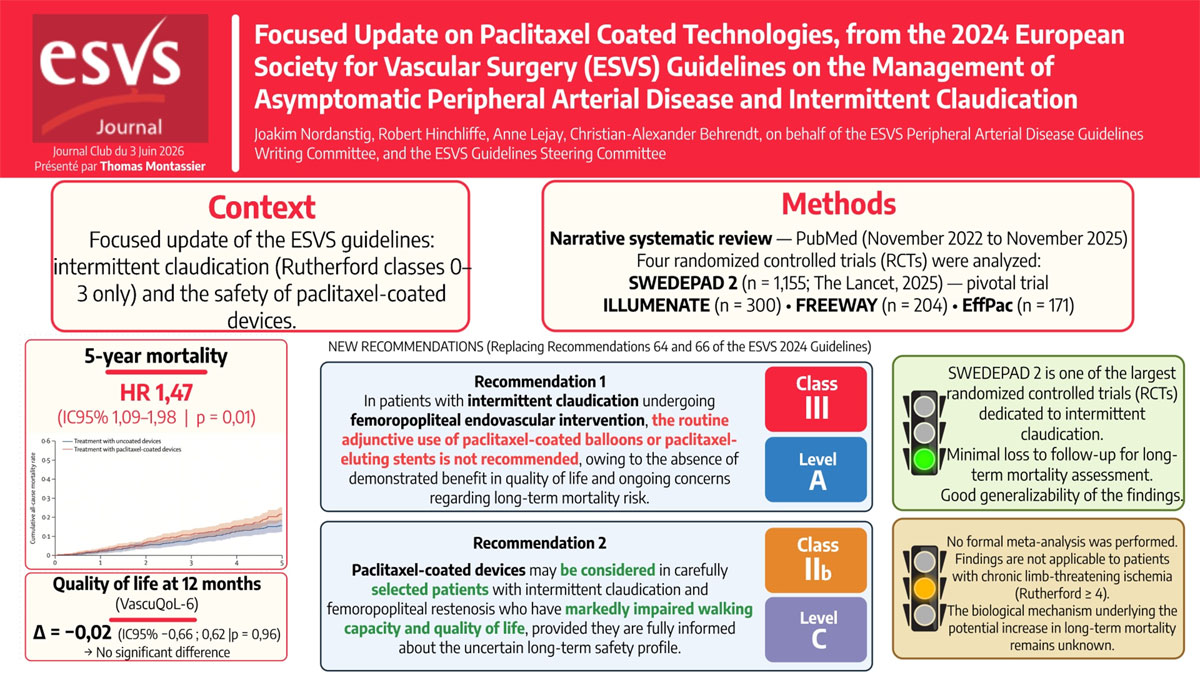
The publication of the SWEDEPAD 2 trial in The Lancet in 2025 provided robust long-term mortality and quality-of-life data, prompting a focused update of the 2024 European Society for Vascular Surgery (ESVS) Guidelines.
References:
Authors: Joakim Nordanstig, Robert Hinchliffe, Anne Lejayd, Christian-Alexander Behrendt, on behalf of the ESVS Peripheral Arterial Disease Guidelines Writing Committee, and the ESVS Guidelines Steering Committee
Reference: Volume 71, Issue 6 p 923-927 June 2026
DOI: DOI: 10.1016/j.ejvs.2026.04.037
Read the abstractObjective:
To provide a focused update of the ESVS Clinical Practice Guidelines on the use of paclitaxel-coated technologies for infrainguinal endovascular interventions in patients with intermittent claudication (Rutherford categories 0–3), in light of emerging evidence on their efficacy and long-term safety.
Study:
Narrative systematic review informing a focused update of the ESVS Clinical Practice Guidelines.
The ESVS Guidelines Writing Committee reviewed evidence from four randomised controlled trials published after the original guideline:
- SWEDEPAD 2 (The Lancet, 2025)
- ILLUMENATE European Randomized Clinical Trial
- FREEWAY Trial
- EffPac Trial
The new evidence was incorporated into updated recommendations using the ESVS Clinical Practice Guidelines recommendation grading system.
Population:
Patients with intermittent claudication (Rutherford categories 0–3) eligible for infrainguinal endovascular revascularisation.
Outcomes:
- 5-year all-cause mortality
- Health-related quality of life at 12 months (VascuQoL-6)
- Target lesion revascularisation
- Updated ESVS recommendations on the use of paclitaxel-coated technologies in intermittent claudication

Get the latest clinical cases and breaking news delivered straight to your inbox!

Discussion
Paclitaxel-coated technologies continue to offer procedural benefits by reducing restenosis and repeat revascularisation.
However, the updated evidence challenges the assumption that these advantages translate into meaningful improvements in patient-reported outcomes and raises persistent concerns regarding long-term mortality.
Although the SWEDEPAD 2 trial provides robust real-world data with extended follow-up, important questions remain regarding the biological mechanisms underlying the potential mortality signal, possible differences between drug-coated balloons and drug-eluting stents, and the role of alternative limus-based technologies.
Conclusion
The updated ESVS recommendations support a stepwise approach to the management of intermittent claudication, prioritising supervised exercise therapy, lifestyle modification and optimal medical treatment.
Endovascular revascularisation should be reserved for patients with persistent lifestyle-limiting symptoms despite conservative management.
When intervention is required, the use of paclitaxel-coated technologies should be individualised through shared decision-making, balancing their procedural benefits against the remaining uncertainty surrounding their long-term safety.