Sirolimus-coated balloon angioplasty for infrainguinal artery disease
Selected in New England Journal of Medicine (NEJM) by Clara Nalin
Peripheral arterial disease (PAD) affects an estimated 113 million people worldwide and represents a significant cause of morbidity and limb-related complications.
Drug-coated balloons have become an established endovascular treatment option, with paclitaxel-coated balloons widely used in clinical practice. Sirolimus offers a cytostatic mechanism of action and has emerged as a potential alternative antiproliferative agent.
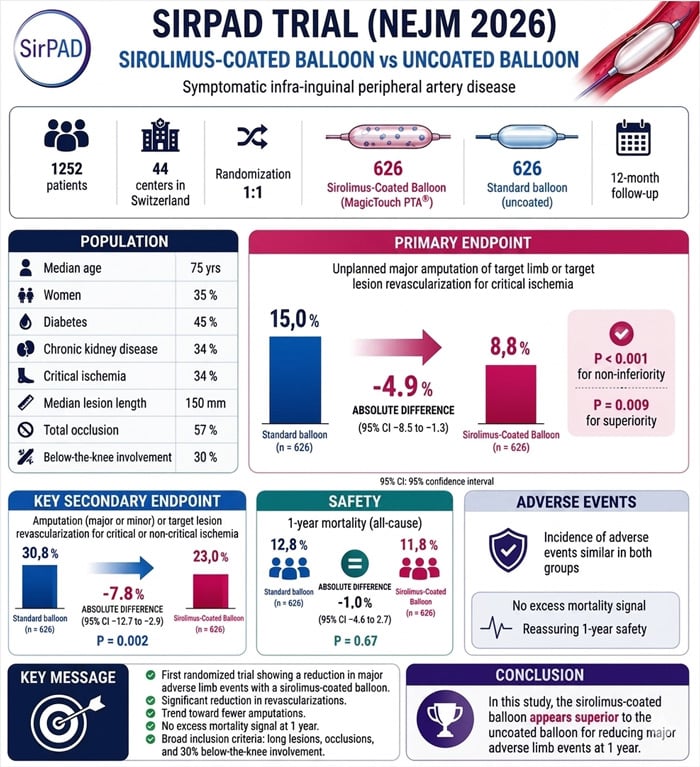
The SirPAD trial evaluated the clinical performance of a sirolimus-coated balloon compared with conventional plain balloon angioplasty in patients with symptomatic infrainguinal arterial lesions.
References:
Authors: Stefano Barco, Rolf P. Engelberger, Ulrike Held, Riccardo M. Fumagalli, Alexandru Grigorean, Daniel Hayoz, Mario Münger, Tim Sebastian, Roman Stadler, Davide Voci, Simon Wolf, Frédéric Baumann, Tobias Tritschler, Conrad von Stempel, Daniel Périard, and Nils Kucher, for the SirPAD Investigators
Reference: This article was published on March 30, 2026, at NEJM.org.
DOI: 10.1056/NEJMoa2600360
Read the abstractObjective:
To determine whether sirolimus-coated balloon angioplasty is non-inferior to uncoated balloon angioplasty regarding major adverse limb events at 1 year in patients with infrainguinal artery disease, with prespecified testing for superiority if non-inferiority was demonstrated.
Study:
- Prospective study
- Multicentre trial conducted in Switzerland
- Open-label design
- Randomised 1:1 allocation
- Sirolimus-coated balloon angioplasty versus plain balloon angioplasty
- Blinded assessment of clinical endpoints
Population:
Patients with symptomatic infrainguinal arterial lesions undergoing endovascular treatment.
Endpoints:
Primary endpoint
Composite of:
- Unplanned major amputation of the target limb
- Endovascular or surgical target lesion revascularisation for critical limb ischaemia within 1 year
Key secondary endpoint
Composite of:
- Any unplanned amputation of the target limb
- Target lesion revascularisation for critical or non-critical limb ischaemia within 1 year
Primary safety endpoint
All-cause mortality at 1 year
Outcomes:
- Sirolimus-coated balloon angioplasty met the criterion for non-inferiority compared with plain balloon angioplasty.
- The sirolimus-coated balloon demonstrated superiority over plain balloon angioplasty for major adverse limb events.
- Benefits were observed in patients with symptomatic infrainguinal arterial disease.
- The treatment reduced the incidence of clinically relevant limb-related events, including unplanned amputation and repeat revascularisation at one year.
Go beyond the paper: watch the interview!

Get the latest clinical cases and breaking news delivered straight to your inbox!

Conclusion:
This study supports the use of sirolimus-coated balloon angioplasty as an effective treatment option for symptomatic infrainguinal artery disease.
The trial enrolled a broad population of patients with infrainguinal artery disease, enhancing the generalisability of the findings.
Importantly, the study reported meaningful clinical outcomes related to patient morbidity rather than solely imaging-based endpoints.
However, the follow-up was limited to one year, and the study population was restricted to a single country, which may limit the generalisability of the results and warrants further long-term evaluation in more diverse populations.