Sirolimus vs paclitaxel: does the benefit hold at 2 years?
Selected in JACC: Cardiovascular Interventions by Alix Piedelièvre
Drug-coated balloons are widely used to treat symptomatic femoropopliteal artery disease, but the choice of antiproliferative drug remains an open question.
The SIRONA trial showed that sirolimus-coated balloon angioplasty was non-inferior to paclitaxel-coated balloon angioplasty at 12 months.
This 2-year analysis looks at whether these results persist over time, comparing patient-reported outcomes, clinical efficacy, vessel patency and safety between the two strategies.
References:
Authors: Ulf Teichgräber, Maja Ingwersen, Thomas Lehmann, Stephanie Platzer, Ina Kunstmann, Sabine Steiner, Andrej Schmidt, Tim Wittig, Thomas Zeller, Marcus Thieme, Hans Krankenberg, Martin Werner, Marianne Brodmann, Nasser Malyar, Stefan Müller-Hülsbeck, Luca de Paoli, Oliver Schlager, Martin Austermann, Gunnar Tepe, Christian Erbel, Wulf Ito, Rainer Waßmer, Lars Maiwald, René Aschenbach, Christian Wissgott, Martin Andrassy, Florian Wolf, Ulrich Beschorner, Maciej Pech, Konstantinos Katsanos, and Dierk Scheinert, the SIRONA Trial Investigators
Reference: JACC: Cardiovascular Interventions Volume 19, Number 16 - 24 August 2026
DOI: DOI: 10.1016/j.jcin.2026.06.021
Read the abstractIntroduction:
Endovascular treatment is frequently used for femoropopliteal lesions in patients with intermittent claudication, but restenosis remains a major limitation. Drug-coated balloons deliver antiproliferative agents to address this issue. Paclitaxel-coated balloons have demonstrated efficacy, but concerns about a potential risk of late mortality have been raised. Sirolimus-coated balloons offer a potential alternative, exerting a cytostatic effect by inhibiting smooth muscle cell proliferation and migration through the mTOR pathway.
The SIRONA randomised non-inferiority trial compared sirolimus- and paclitaxel-coated balloons in symptomatic femoropopliteal lesions. At 12 months, the sirolimus-coated balloon was non-inferior to the paclitaxel-coated balloon for primary patency and a composite clinical endpoint including freedom from target-vessel revascularisation, major amputation, and device- or procedure-related death. This study evaluates the efficacy and safety of both strategies at 2 years.
Objective:
To evaluate the efficacy and safety at 2 years of sirolimus- versus paclitaxel-coated balloon angioplasty in patients with symptomatic femoropopliteal artery lesions.
Study:
Prospective, multicentre, randomised 1:1, non-inferiority trial conducted at 25 centres in Germany and Austria. A total of 482 patients were randomised to sirolimus-coated balloon angioplasty (SCB; Magic Touch) or paclitaxel-coated balloon angioplasty (PCB). Patients, the core laboratory analysing imaging, and the clinical events adjudication committee were blinded to treatment allocation.
Population:
Patients with symptomatic femoropopliteal artery disease, predominantly Rutherford class 2–3, with a mean lesion length of 84 mm. Total occlusions accounted for 34% of lesions.
Outcomes:
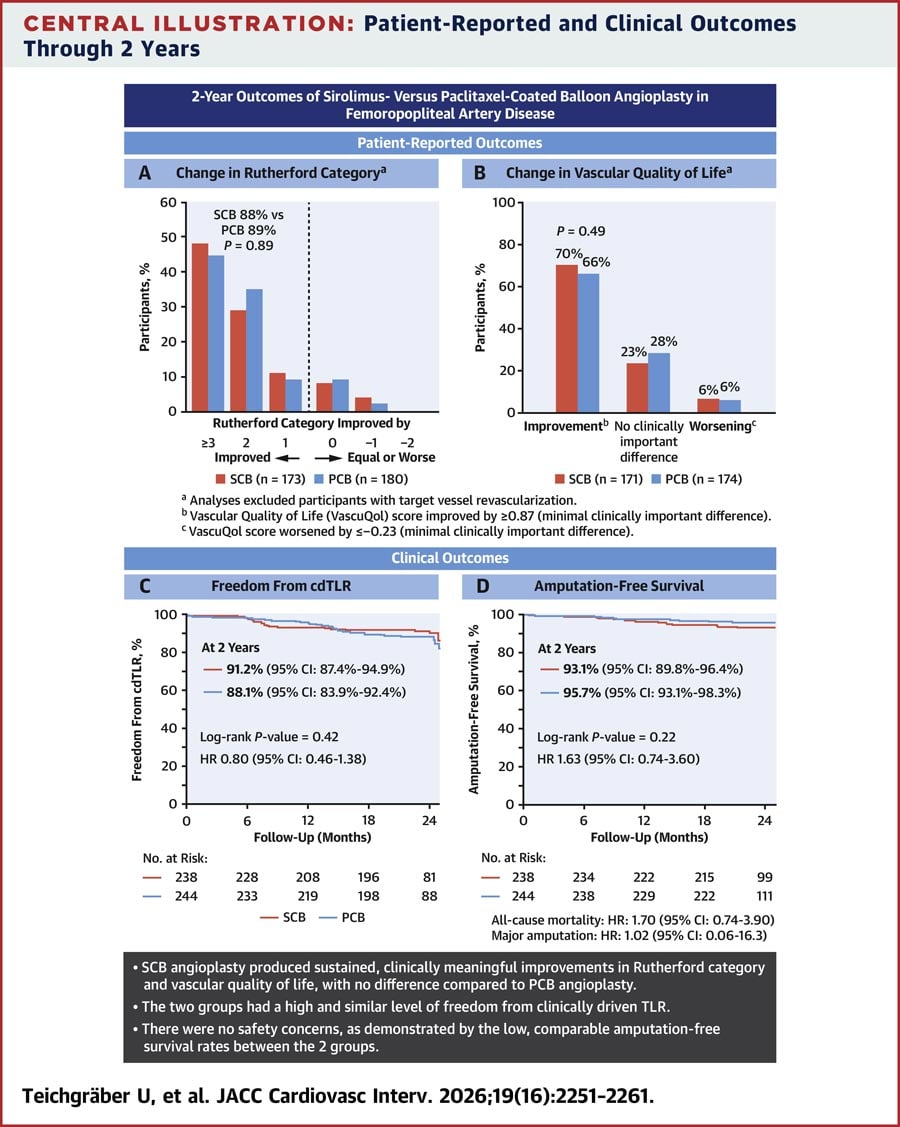
At 2 years, clinical, patient-reported and patency outcomes were comparable between sirolimus- and paclitaxel-coated balloons.
- Clinical improvement: ≥1 Rutherford category in 88% vs 89% of patients (P=0.89).
- Vascular quality of life: improvement in 70% vs 66% of patients; no clinically important worsening in 23% vs 28% (P=0.49).
- Primary patency: 64.6% vs 67.2% (P=0.34).
- Freedom from clinically driven target-lesion revascularisation: 91.2% vs 88.1% (P=0.42).
- Major amputation: 1 patient in each group (0.4%).
- All-cause mortality: 6.3% vs 3.7% (P=0.21).
- Device- or procedure-related deaths: none in either group

Get the latest clinical cases and breaking news delivered straight to your inbox!

Discussion
Strengths
Limitations
Conclusion
At 2 years, sirolimus-coated balloon angioplasty showed clinical outcomes and primary patency comparable to paclitaxel-coated balloon angioplasty in patients with symptomatic femoropopliteal artery disease.
No device- or procedure-related safety signal was identified.
Longer-term follow-up to 5 years will be important to confirm the durability and long-term safety of this treatment strategy.