Smoking cessation in PAD: is cutting down enough?
Selected in JAMA by Lubin Alonzo
Smoking is one of the most important modifiable risk factors in peripheral artery disease (PAD), yet changing smoking behaviour after diagnosis remains challenging.
While complete cessation is recommended, it is less clear whether reducing cigarette consumption can also translate into better cardiovascular and limb outcomes.
This nationwide Korean cohort study followed smokers aged over 40 years with PAD who were smokers before diagnosis, examining how changes in smoking behaviour after diagnosis were associated with subsequent major cardiovascular and limb events over approximately five years.
By comparing patients who quit, reduced their consumption or continued smoking, the study provides new insight into whether cutting down is enough, or whether complete cessation is needed to meaningfully change the risk trajectory in PAD.
References:
Authors: Hyo Kee Kim, Mi-Sook Kim, Sanghyun Ahn, Sangil Min, Seung-Kee Min, Jongwon Ha, Ahram Han
Reference: Published: August 19, 2026
DOI: DOI: 10.1001/jamanetworkopen.2026.29337
Read the abstractRationale & clinical context
Peripheral artery disease (PAD) has a substantial clinical burden, ranging from claudication and rest pain to major amputation. Smoking is the most powerful modifiable risk factor for PAD.
However, longitudinal data on the impact of changes in smoking behaviour after PAD diagnosis remain limited. A nationwide population-based cohort study was therefore conducted to examine the association between smoking cessation after diagnosis and the occurrence of cardiovascular and limb-specific events.
Objective:
To examine the association between changes in smoking behaviour after PAD diagnosis and the subsequent risk of cardiovascular and limb-specific events.
Study:
Design:
Retrospective, population-based cohort study using the South Korean National Health Insurance database.
Study period:
2011–2018.
Follow-up:
From the post-diagnosis assessment of smoking status to 31 December 2021, with a mean follow-up of approximately 5 years.
The PAD diagnosis was based on an ICD-10 code combined with a prescription for antithrombotic therapy. Patients with vasospastic disease or acute limb ischaemia were excluded.
Population:
The study included patients aged over 40 years who were smokers before their PAD diagnosis and were identified through the South Korean National Health Insurance database between 2011 and 2018.
PAD was defined by an ICD-10 diagnosis code combined with a prescription for antithrombotic therapy. Patients with vasospastic disease or acute limb ischaemia were excluded.
To assess changes in smoking behaviour, patients had to have undergone health examinations both before and after PAD diagnosis.
Endpoints:
Primary endpoint:
MACCE (major adverse cardiovascular and cerebrovascular events)
Composite of:
- All-cause mortality
- Myocardial infarction
- Coronary revascularisation
- Ischaemic stroke
Secondary endpoint:
MALE (major adverse limb events)
Composite of:
- Limb revascularisation
- Major amputation
Outcomes:
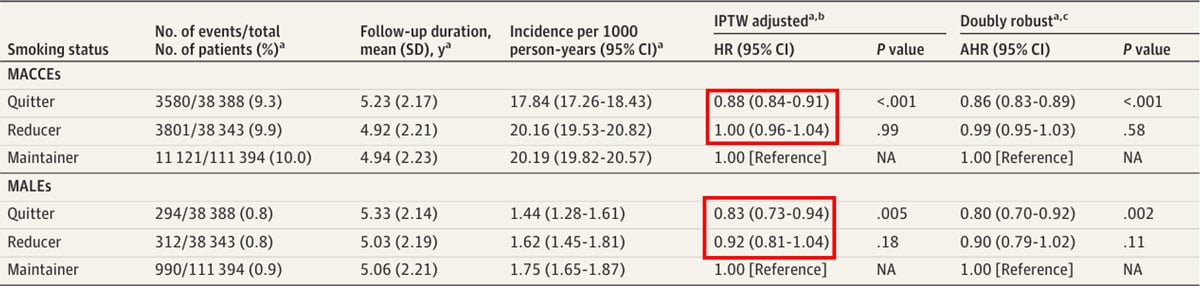
During a mean follow-up of 5.0 years for MACCEs and 5.1 years for MALEs, 18,502 MACCEs and 1,596 MALEs occurred.
MACCEs
Complete smoking cessation was associated with a significantly lower risk of MACCEs compared with continued smoking. The incidence was 17.8 vs 20.2 events per 1,000 person-years in quitters and maintainers, respectively (HR, 0.88; 95% CI, 0.84–0.91).
In contrast, reducing cigarette consumption was not associated with a lower risk of MACCEs. The incidence was 20.2 events per 1,000 person-years among reducers (HR, 1.00; 95% CI, 0.96–1.04).
The association between smoking cessation and lower MACCE risk remained consistent across most subgroups, including patients aged 65 years or older, those with previous peripheral revascularisation, low physical activity or severe kidney impairment. Hazard ratios for these higher-risk groups ranged from 0.66 to 0.90, although the association was less precise in patients with severe kidney impairment (HR, 0.77; 95% CI, 0.57–1.03). Smoking reduction was not associated with a significant reduction in MACCE risk in any subgroup examined.
MALEs
Smoking cessation was also associated with a lower incidence of MALEs: 1.4 vs 1.8 events per 1,000 person-years for quitters and maintainers, respectively (HR, 0.83; 95% CI, 0.73–0.94; P = .005).
The reduction in MALE risk was mainly driven by fewer peripheral revascularisations (HR, 0.80; 95% CI, 0.69–0.92). The study did not demonstrate a significant reduction in major amputation, possibly reflecting the low number of events and limited statistical power.
Again, smoking reduction alone was not associated with a significant reduction in MALE risk (1.6 events per 1,000 person-years; HR, 0.92; 95% CI, 0.81–1.04; P = .18).
Dose-response relationship
Restricted cubic spline analyses showed that the risk of MACCEs remained close to that observed with continued smoking for mild-to-moderate reductions in cigarette consumption. A statistically significant reduction in MACCE risk emerged only at approximately 75% smoking reduction.
For MALEs, the risk also showed a gradual downward trend with increasing smoking reduction, but confidence intervals remained wide until near-complete cessation. When absolute post-diagnosis cigarette consumption was considered, the risk of both MACCEs and MALEs increased progressively with increasing daily cigarette consumption, with elevated risks apparent even at relatively low levels of continued smoking.

Get the latest clinical cases and breaking news delivered straight to your inbox!

Strengths and limitations:
Strengths
Limitations
Conclusion
In patients with peripheral artery disease, complete smoking cessation was associated with a lower risk of major cardiovascular and limb events over approximately five years, whereas reducing cigarette consumption alone was not. These findings reinforce the importance of complete smoking cessation as a key component of PAD management.