SWEDEPAD 1 & 2: binary restenosis after paclitaxel-coated devices
Selected in ESVS Journal by Clara Nalin
Paclitaxel-coated balloons and stents are widely used in infrainguinal PAD to limit neointimal hyperplasia and improve patency, but their clinical benefit remains debated.
In the SWEDEPAD 1 and 2 trials, no overall advantage over uncoated devices was shown, leaving their impact on restenosis uncertain.
References:
Authors: Tom Le Corvec, Mårten Falkenberg, Björn Kragsterman, Fredrik Sellgren, Birgitta Sigvant, Joakim Nordanstig
Reference: Published online March 27, 2026
DOI: 10.1016/j.ejvs.2026.03.037
Read the abstractIntroduction:
Endovascular revascularisation is a cornerstone of treatment for symptomatic peripheral arterial disease (PAD), but restenosis remains a major limitation, often leading to target vessel reintervention (TVR).
Paclitaxel-coated balloons and stents are widely used to reduce neointimal hyperplasia, yet their long-term efficacy and safety remain debated.
While the SWEDEPAD 1 and 2 trials found no overall clinical benefit over uncoated devices, a reduction in TVR was observed at one year in patients with chronic limb-threatening ischaemia (CLTI), raising the question of whether paclitaxel-coated devices truly reduce restenosis.
Objective:
This exploratory sub-analysis of the SWEDEPAD 1 and 2 trials evaluated whether paclitaxel-coated devices reduce one-year binary restenosis, a surrogate marker of neointimal hyperplasia.
The analysis included patients with one-year duplex ultrasound follow-up who had not undergone target vessel reintervention (TVR).
Study:
Exploratory sub-analysis of the multicentre SWEDEPAD 1 and 2 randomised controlled trials, based on the Swedish Swedvasc registry.
One-year duplex ultrasound was encouraged but not mandated by the protocol and was performed during routine follow-up by operators blinded to treatment allocation.
Population:
A total of 644 patients had one-year duplex ultrasound available (383 from SWEDEPAD 1 and 261 from SWEDEPAD 2).
Patients who underwent target vessel reintervention (TVR) within the first year were excluded from the analysis.
Baseline characteristics were generally comparable to those of the overall trial populations.
Endpoints:
The primary endpoint was one-year binary restenosis, defined as ≥50% luminal diameter reduction on duplex ultrasound (peak systolic velocity ratio ≥2.5), a standard surrogate marker of neointimal hyperplasia.
Outcomes:
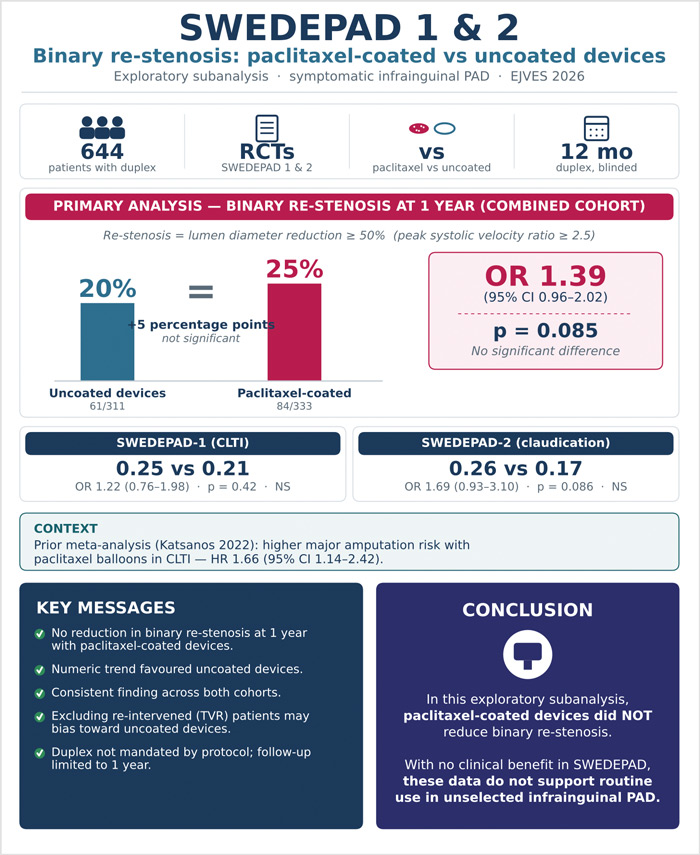
In the combined SWEDEPAD 1 and 2 cohort, one-year binary restenosis occurred in 25% of patients treated with paclitaxel-coated devices versus 20% with uncoated devices (84/333 vs 61/311), with no statistically significant difference (odds ratio 1.39; 95% CI 0.96–2.02; p = 0.085).
When analysed separately, results were consistent across SWEDEPAD 1 (25% vs 21%) and SWEDEPAD 2 (26% vs 17%), showing a numerical but non-significant trend towards higher restenosis with paclitaxel-coated devices.

Get the latest clinical cases and breaking news delivered straight to your inbox!

Discussion:
This analysis provides clinically relevant data on binary restenosis, a surrogate marker of neointimal hyperplasia, in a substantial subset of patients from the SWEDEPAD trials. Ultrasound assessments were performed by operators blinded to treatment allocation, strengthening the internal validity of the findings.
However, several limitations should be acknowledged, including the exclusion of patients who underwent target vessel reintervention within the first year, which may have introduced a bias in favour of uncoated devices. In addition, duplex ultrasound was not mandated by protocol, resulting in incomplete follow-up imaging, and the analysis was limited to one-year outcomes only.
Conclusion
This exploratory sub-analysis shows no reduction in one-year binary restenosis with paclitaxel-coated devices. Together with the absence of clinical benefit observed in the SWEDEPAD trials, these findings do not support their routine use in an unselected infrainguinal PAD population.
As restenosis prevention remains a key objective in endovascular therapy, future research should focus on the development of novel devices and drug-delivery technologies.