Clinical algorithms and challenges in PAD: revascularisation strategies
Translating evidence into bedside decisions, and the gaps that still complicate them.
 This article examines the role of drug-coated balloons, drug-eluting stents and vessel preparation in femoropopliteal disease and in-stent restenosis, alongside the challenges of managing chronic limb-threatening ischaemia. It explores how lesion characteristics, clinical presentation and procedural outcomes guide treatment selection, while highlighting unresolved questions in revascularisation strategies, clinical evidence and antithrombotic therapy.


Selecting the optimal treatment strategy extends beyond device performance and depends on the interaction between clinical presentation, anatomical and lesion characteristics, procedural objectives, and operator experience.
Clinical presentation influences treatment goals, as clearly discussed in the previous chapter. In patients with intermittent claudication, the 2024 ACC/AHA guideline1, 2025 SVS focused update2, and 2026 ESVS focused update3 emphasize education, optimal medical therapy, structured exercise, symptom burden, patient goals, and durability before elective revascularisation. Once revascularisation is deemed appropriate, symptom relief and preservation of future treatment options favour a “leave as little behind as possible” approach, making drug-coated balloon (DCB) angioplasty an attractive option whenever an adequate angiographic result can be achieved without permanent scaffolding.
Vessel preparation: an enabling technology
Vessel preparation has become an integral component of contemporary endovascular therapy, as it can modify lesion characteristics and address lesion complexity. Technologies such as atherectomy4, scoring balloons, cutting balloons, and intravascular lithotripsy5 are designed to modify plaque morphology, improve vessel compliance, facilitate balloon expansion, and reduce severe dissections before definitive treatment with drug-eluting technologies6. A 2025 network meta-analysis of four randomised trials involving 549 patients treated for femoropopliteal lesions found no significant difference in 1-year freedom from target lesion revascularisation (TLR), amputation, or mortality when atherectomy or intravascular lithotripsy was used before DCB angioplasty, although bailout stenting was reduced7. A 2026 meta-analysis of seven randomised controlled trials (RCTs) similarly found less bailout stenting and fewer flow-limiting dissections with atherectomy, with signals for improved 6-month patency and clinically driven TLR (CD-TLR), but no significant improvement in 12-month patency, TLR, amputation, or mortality in below-the-knee (BTK) lesions8.
By optimising the vessel substrate, these techniques may enhance drug transfer into the vessel wall while decreasing the likelihood of bailout stenting. Studies have consistently demonstrated that achieving residual stenosis of less than 30% and a dissection grade below C before DCB deployment is independently associated with superior primary patency9. The angiographic result following vessel preparation therefore guides definitive therapy: when adequate luminal gain is achieved with minimal residual stenosis and no flow-limiting dissection, DCB angioplasty alone is appropriate. Conversely, persistent recoil or significant dissection generally necessitates mechanical scaffolding, most commonly with a drug-eluting stent (DES).
However, evidence that vessel preparation independently improves long-term patency remains limited. Similarly, although plaque modification may facilitate more uniform balloon expansion and potentially enhance drug delivery, robust clinical data linking improved drug uptake to superior long-term outcomes are still lacking. Consequently, the potential benefits of lesion preparation must be weighed against the additional procedural time, complexity, and cost associated with these techniques.
Regardless of the device strategy employed, the overarching goal of endovascular therapy remains an optimal angiographic result, defined by minimal residual stenosis, ideally less than 30%, without flow-limiting dissection. In this context, lesion assessment and preparation should be viewed as tools to optimise procedural conditions and increase the likelihood of a durable result, rather than as standalone determinants of long-term efficacy.
Rather than viewing DCB and DES as competing technologies, the emphasis should be on achieving the best possible overall treatment strategy for each patient. Durable outcomes depend not only on device selection but also on the integration of careful lesion assessment, tailored lesion preparation, optimal procedural execution, guideline-directed medical therapy, and comprehensive secondary prevention.
A practical femoropopliteal algorithm
- Confirm that revascularisation is indicated and define the clinical objective: symptom relief, wound healing, limb salvage, or prevention of recurrent events.
- Characterise the lesion: length, occlusion, calcification, thrombotic burden, vessel diameter, inflow and outflow, and previous stent or bypass history.
- Prepare the vessel selectively, using specific devices only when lesion morphology predicts inadequate balloon expansion, recoil, or flow-limiting dissection. Atherectomy, specialty balloons, and intravascular lithotripsy are tools, not mandatory steps.
- If the final angiographic result is satisfactory, a DCB-based strategy can avoid additional permanent scaffolding.
- If significant recoil or flow-limiting dissection persists, provisional or planned DES implantation can provide mechanical support.
- Continue guideline-directed medical therapy and determine the surveillance strategy according to clinical presentation and device strategy.
Pathophysiology of FP ISR and rationale for drug elution
Bare nitinol stents in the femoropopliteal segment are associated with in-stent restenosis (ISR) rates of approximately 18–40% at 1 year10-11. Unlike de novo disease, ISR represents failure within a previously treated arterial segment and may result from several interacting mechanisms, including neointimal hyperplasia, stent underexpansion, fracture, persistent or recurrent calcification, thrombotic material, and disease progression at the stent edges. Mechanical injury induced by angioplasty and stent implantation triggers smooth muscle cell activation, proliferation, and migration, together with extracellular matrix deposition, progressively leading to recurrent lumen loss. The mechanical environment of the femoropopliteal artery further contributes to this process, as repetitive flexion, compression, and torsion may cause stent deformation or fracture and perpetuate local vessel injury.
This heterogeneous pathophysiology explains why ISR requires a tailored device strategy. The first objective is to identify and correct the mechanical substrate of restenosis and restore an adequate lumen; the second is to suppress the biological response driving recurrent neointimal proliferation. Debulking devices, such as atherothrombectomy systems (Rotarex©) or atherectomy devices (excimer laser, excisional, or rotational atherectomy), may therefore be useful when thrombotic material, obstructive neointimal tissue, or recurrent occlusion prevents adequate lumen restoration. Once the lumen has been adequately prepared, DCB therapy offers the advantage of delivering an antiproliferative drug without adding another permanent metallic layer. A 2026 meta-analysis of seven studies involving 584 patients found that debulking plus DCB therapy was associated with lower 12-month target lesion revascularisation (TLR), with the strongest signal in lesions longer than 20 cm or Tosaka class III occlusions, although overall primary patency at 6 and 12 months did not differ significantly12. These findings support a mechanism-based approach: in relatively straightforward Tosaka class I and II ISR, lesion preparation followed by antiproliferative therapy may be sufficient, whereas Tosaka class III ISR may benefit from a combined debulking and drug-based strategy13.
Evidence for DES and DCBs in femoropopliteal disease and ISR
Although most randomised data focus on de novo femoropopliteal lesions, several studies have specifically evaluated ISR. A meta-analysis of three randomised controlled trials (RCTs) showed that DCB angioplasty significantly reduced the risk of target lesion revascularisation (TLR) and recurrent ISR compared with plain old balloon angioplasty (POBA) (hazard ratio for TLR: 0.25 [95% CI, 0.14–0.46]; p < 0.001)14. The IN.PACT Global registry also reported an acceptable 1-year rate of clinically driven TLR (CD-TLR) of 7.3%15. Furthermore, the prospective, multicentre, single-arm Zilver PTX study, which enrolled 787 patients, included a subgroup of 108 patients with 119 ISR lesions16. Mean lesion length was 133.0 ± 91.7 mm; 33.6% of lesions were longer than 150 mm, and 31.1% were totally occluded (Tosaka class III lesions). Primary patency was 78.8% at 1 year, while freedom from TLR was 81.0% at 1 year and 60.8% at 2 years.
Taken together, these data support drug-based therapy as a central component of femoropopliteal ISR treatment, but they also highlight an important distinction between suppressing recurrent neointimal proliferation and providing sufficient mechanical support. DCBs are attractive when adequate luminal expansion can be achieved without additional scaffolding, whereas DES implantation remains relevant when recoil, extensive dissection, residual obstructive tissue, or an unstable mechanical substrate prevents an adequate result with balloon-based therapy alone. Data from Zilver PTX and Eluvia support the use of drug-eluting stents in selected restenotic lesions, with promising data also emerging from newer limus-based platforms.
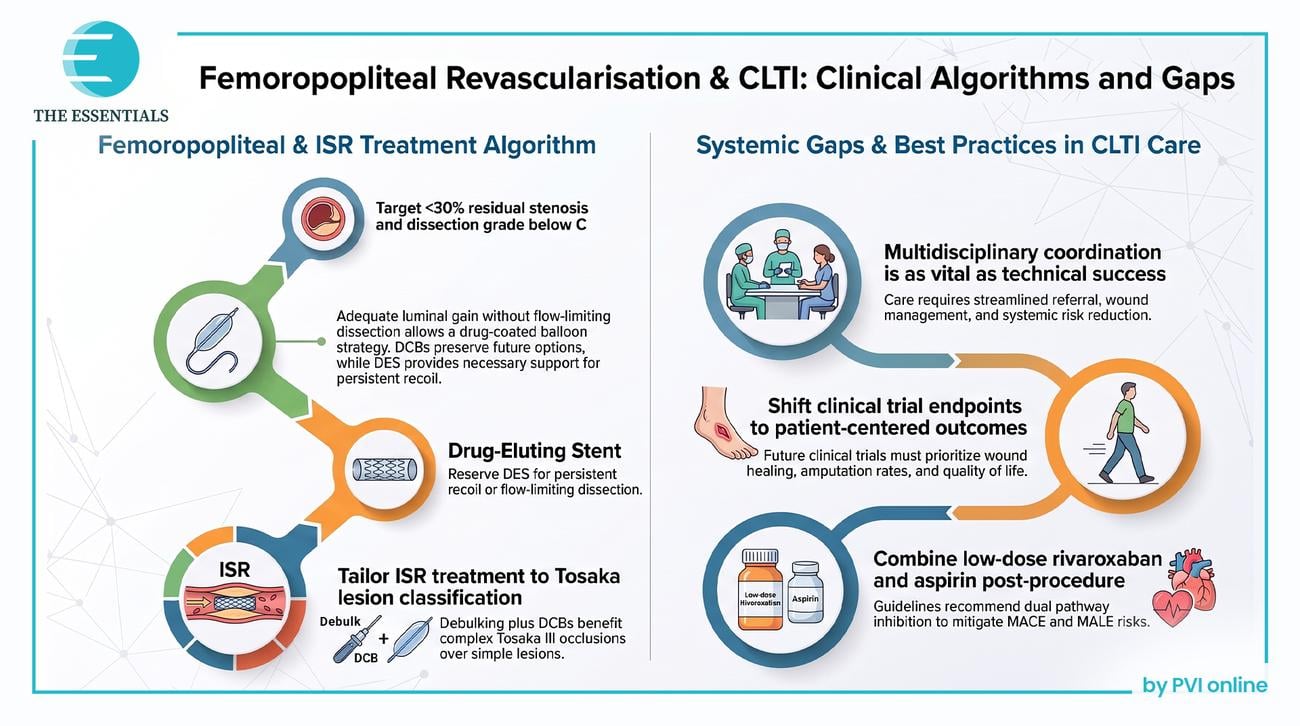
Given the significant morbidity and mortality associated with chronic limb-threatening ischaemia (CLTI), early diagnosis and intervention are crucial to preserving limb function and overall health17. Prognosis is determined not only by the severity and distribution of arterial disease but also by tissue loss, infection, comorbidities, functional status, and competing cardiovascular risks. Management therefore requires a multidisciplinary approach involving vascular surgeons, interventionalists, wound care specialists, podiatrists, vascular physicians, diabetes specialists, infectious disease physicians, and, when required, orthopaedic and reconstructive teams. The complexity of CLTI is reflected in its frequent combination of long, diffuse, heavily calcified, and occlusive lesions, often involving multiple arterial levels. However, the treatment target in CLTI is not the artery in isolation: the relevant unit of care is the patient and the threatened limb.
Contemporary evidence indicates that the major shortcomings in CLTI management extend well beyond the technical aspects of revascularisation. Important gaps remain in evidence implementation, organisation of care, timely referral, multidisciplinary coordination, and the delivery of comprehensive cardiovascular and limb-focused secondary prevention18-20. These limitations are particularly relevant because patients at greatest risk often have the greatest burden of comorbidities and the most complex anatomy, precisely the populations in whom extrapolation from highly selected device trials is most difficult.
Although advances in endovascular and surgical treatment have expanded limb-salvage options, the optimal revascularisation strategy remains incompletely defined across many anatomical patterns and clinical scenarios. BEST-CLI21 supports bypass surgery in selected patients with a suitable great saphenous vein, whereas BASIL-2 supports an endovascular-first strategy in its infrapopliteal study population22. Accordingly, the choice between surgical, endovascular, and hybrid strategies must remain individualised and should incorporate conduit availability, anatomical complexity, expected survival, limb threat, procedural risk, and patient goals.
Major unresolved questions remain in the endovascular management of CLTI. These include the role of drug-eluting technologies below the knee; the optimal target vessel and revascularisation strategy for wound healing; whether single- or multivessel tibial recanalisation provides additional clinical benefit; the management of below-the-ankle disease; and the role of temporary drug-eluting scaffolds in longer or more complex lesions. For many of these questions, angiographic patency remains an insufficient surrogate for the outcomes that matter most to patients.
Clinical trials are therefore poised to play a pivotal role in advancing CLTI care. Future studies should move beyond device-specific measures of technical success and incorporate outcomes that capture the full clinical trajectory of the patient, including limb-related events, wound healing, amputation, functional status, quality of life, symptom burden, and mortality. Standardisation of patient-reported outcome measures (PROMs), endpoint definitions, adjudication methods, follow-up duration, and health-economic assessments will be essential to enable meaningful comparisons across technologies and treatment strategies.
Future research initiatives should also address the persistent underrepresentation of populations at high risk of severe peripheral artery disease (PAD), including patients with diabetes, advanced chronic kidney disease, frailty, severe calcification, and complex multilevel disease23.
Evidence on medical therapy and comprehensive cardiovascular risk reduction remains insufficient, and implementation is inconsistent compared with coronary artery disease and cerebrovascular disease24. Despite strong recommendations for medical therapy in PAD, the implementation of optimal medical therapy—including lipid lowering, blood pressure control, diabetes management, antithrombotic therapy, and smoking cessation—remains suboptimal.
In parallel, CLTI care pathways remain insufficiently coordinated, with delayed diagnosis, late referral, and limited availability of streamlined multidisciplinary pathways contributing to potentially avoidable amputations and mortality. Access to specialist evaluation and limb-salvage treatment is also influenced by structural, geographic, socioeconomic, and healthcare system factors. These disparities may correlate with race, ethnicity, sex, or other demographic characteristics, but should not be interpreted as evidence of intrinsic biological differences without appropriate supporting evidence25,26. Addressing these barriers requires improvements in referral pathways, access to specialist care, multidisciplinary coordination, patient education, transportation and digital connectivity, and continuity of care.
While considerable progress has been made in recognizing and treating CLTI, the next major gains in CLTI care are unlikely to come from revascularisation technology alone. Efforts to enhance early recognition, multidisciplinary care, and tailored management strategies remain essential. Population-level strategies addressing prevention and cardiovascular risk, combined with coordinated limb-salvage pathways, may be critical to translating technical advances in revascularisation into meaningful improvements in survival, limb preservation, function, and quality of life.
Antithrombotic therapy remains device- and patient-dependent
Current guidance supports antithrombotic therapy after lower-extremity revascularisation, with the choice and duration determined by the balance between thrombotic and bleeding risks, the clinical presentation, and the type and complexity of revascularisation. The 2024 ACC/AHA guideline supports low-dose rivaroxaban (2.5 mg twice daily) combined with low-dose aspirin after lower-extremity revascularisation in patients without an increased bleeding risk, to reduce major adverse cardiovascular events (MACE) and major adverse limb events (MALE). Dual antiplatelet therapy is also considered reasonable for a limited period after endovascular revascularisation1.
Important unanswered questions remain, particularly regarding the optimal duration of antithrombotic therapy after drug-coated balloon (DCB), drug-eluting stent (DES), or resorbable scaffold implantation; the management of patients with CLTI, advanced chronic kidney disease (CKD), or high bleeding risk; and the treatment of patients who already require full-dose anticoagulation1,27.
- Gornik HL, Aronow HD, Goodney PP, Arya S, Brewster LP, Byrd L, et al. 2024 ACC/AHA/AACVPR/APMA/ABC/SCAI/SVM/SVN/SVS/SIR/VESS Guideline for the Management of Lower Extremity Peripheral Artery Disease: A Report of the American College of Cardiology/American Heart Association Joint Committee on Clinical Practice Guidelines. Circulation. 2024 Jun 11;149(24):e1313–410. doi:10.1161/CIR.0000000000001251 PubMed PMID: 38743805; PubMed Central PMCID: PMC12782132.
- Conte MS, Aulivola B, Barshes NR, Bertges DJ, Corriere MA, Murad MH, et al. Society for Vascular Surgery Clinical Practice Guideline on the management of intermittent claudication: Focused update. J Vasc Surg. 2025 Aug;82(2):303-326.e11. doi:10.1016/j.jvs.2025.04.041 PubMed PMID: 40316185.
- Nordanstig J, Hinchliffe R, Lejay A, Behrendt CA, Baumgartner I, Belch J, et al. Editor’s Choice – Focused Update on Paclitaxel Coated Technologies, from the 2024 European Society for Vascular Surgery (ESVS) Guidelines on the Management of Asymptomatic Peripheral Arterial Disease and Intermittent Claudication. Eur J Vasc Endovasc Surg. 2026 Jun 1;71(6):923–7. doi:10.1016/j.ejvs.2026.04.037 PubMed PMID: 42248619.
- Zeller T, Langhoff R, Rocha-Singh KJ, Jaff MR, Blessing E, Amann-Vesti B, et al. Directional Atherectomy Followed by a Paclitaxel-Coated Balloon to Inhibit Restenosis and Maintain Vessel Patency: Twelve-Month Results of the DEFINITIVE AR Study. Circ Cardiovasc Interv. 2017 Sep;10(9). doi:10.1161/CIRCINTERVENTIONS.116.004848 PubMed PMID: 28916599; PubMed Central PMCID: PMC5610565.
- Armstrong EJ, Adams G, Soukas PA, Mangalmurti SS, Shammas NW, Mehrle A, et al. Intravascular Lithotripsy for Peripheral Artery Calcification: 30-Day Outcomes From the Disrupt PAD III Observational Study. J Endovasc Ther Off J Int Soc Endovasc Spec. 2026 Apr;33(2):853–62. doi:10.1177/15266028241283716 PubMed PMID: 39422234; PubMed Central PMCID: PMC12972088.
- Korosoglou G, Schmidt A, Lichtenberg M, Malyar N, Stavroulakis K, Reinecke H, et al. Global Algorithm for the Endovascular Treatment of Chronic Femoropopliteal Lesions: An Interdisciplinary Expert Opinion Statement. JACC Cardiovasc Interv. 2025 Mar 10;18(5):545–57. doi:10.1016/j.jcin.2024.11.038 PubMed PMID: 40074516.
- Yiu J, Tippireddy R, Biasi L, Patel S, Saha P, Saratzis A, et al. Systematic Review and Network Meta-analysis of Vessel Preparation Techniques With Plain Balloon Angioplasty, Atherectomy, or Intravascular Lithotripsy Before Application of a Drug Coated Balloon to Treat Atherosclerotic Femoropopliteal Disease. Eur J Vasc Endovasc Surg. 2025 Jan 1;69(1):118–29. doi:10.1016/j.ejvs.2024.08.002 PubMed PMID: 39121903.
- Wu H, Zheng D, Zhou L, Wang Q, Wang T, Liang S. A Systematic Review and Meta-analysis of Atherectomy Plus Balloon Angioplasty Versus Balloon Angioplasty Alone for Infrapopliteal Arterial Disease. J Endovasc Ther Off J Int Soc Endovasc Spec. 2025 Aug;32(4):957–68. doi:10.1177/15266028231209236 PubMed PMID: 37933456.
- Tomoi Y, Soga Y, Hirano T, Tsunoda K, Ando K. Long-Term Clinical Impact of Successful Vessel Preparation in Femoropopliteal Drug-Coated Balloon Angioplasty. Catheter Cardiovasc Interv Off J Soc Card Angiogr Interv. 2025 Sep;106(3):1543–50. doi:10.1002/ccd.31705 PubMed PMID: 40563207.
- Laird JR, Katzen BT, Scheinert D, Lammer J, Carpenter J, Buchbinder M, et al. Nitinol stent implantation versus balloon angioplasty for lesions in the superficial femoral artery and proximal popliteal artery: twelve-month results from the RESILIENT randomized trial. Circ Cardiovasc Interv. 2010 Jun 1;3(3):267–76. doi:10.1161/CIRCINTERVENTIONS.109.903468 PubMed PMID: 20484101.
- Schillinger M, Sabeti S, Loewe C, Dick P, Amighi J, Mlekusch W, et al. Balloon angioplasty versus implantation of nitinol stents in the superficial femoral artery. N Engl J Med. 2006 May 4;354(18):1879–88. doi:10.1056/NEJMoa051303 PubMed PMID: 16672699.
- Cheng C, Zhen Y, Hu Y, Yang J, Liu T, Zheng J. Debulking Combined with Drug-Coated Balloon for the Treatment of Femoropopliteal In-Stent Restenosis: A Systematic Review and Meta-Analysis. J Vasc Interv Radiol JVIR. 2026 Jun 15;108904. doi:10.1016/j.jvir.2026.108904 PubMed PMID: 42297236.
- Tosaka A, Soga Y, Iida O, Ishihara T, Hirano K, Suzuki K, et al. Classification and clinical impact of restenosis after femoropopliteal stenting. J Am Coll Cardiol. 2012 Jan 3;59(1):16–23. doi:10.1016/j.jacc.2011.09.036 PubMed PMID: 22192663.
- Cassese S, Wolf F, Ingwersen M, Kinstner CM, Fusaro M, Ndrepepa G, et al. Drug-Coated Balloon Angioplasty for Femoropopliteal In-Stent Restenosis. Circ Cardiovasc Interv. 2018 Dec;11(12):e007055. doi:10.1161/CIRCINTERVENTIONS.118.007055 PubMed PMID: 30562083.
- Brodmann M, Keirse K, Scheinert D, Spak L, Jaff MR, Schmahl R, et al. Drug-Coated Balloon Treatment for Femoropopliteal Artery Disease: The IN.PACT Global Study De Novo In-Stent Restenosis Imaging Cohort. JACC Cardiovasc Interv. 2017 Oct 23;10(20):2113–23. doi:10.1016/j.jcin.2017.06.018
- Zeller T, Dake MD, Tepe G, Brechtel K, Noory E, Beschorner U, et al. Treatment of femoropopliteal in-stent restenosis with paclitaxel-eluting stents. JACC Cardiovasc Interv. 2013 Mar;6(3):274–81. doi:10.1016/j.jcin.2012.12.118 PubMed PMID: 23517839.
- Sean W. Dooley M, Eric A. Secemsky M, Michael R. Jaff M. Addressing the Complexities and Disparities in Critical Limb-Threatening Ischemia Care. J Crit Limb Ischemia [Internet]. 2024 Mar 14 [cited 2026 Sep 30];4(1). Available from: https://www.hmpgloballearningnetwork.com/site/jcli/editorialcommentary/addressing-complexities-and-disparities-critical-limb-threatening
- Pernat AM, Peršič V, Usvyat L, Saunders L, Rogus J, Maddux FW, et al. Implementation of routine foot check in patients with diabetes on hemodialysis: associations with outcomes. BMJ Open Diabetes Res Care. 2016 Mar 3;4(1). doi:10.1136/bmjdrc-2015-000158 PubMed PMID: 10.1136/bmjdrc-2015-000158.
- Oude Wesselink SF, Lingsma HF, Robben PBM, Mackenbach JP. Guideline adherence and health outcomes in diabetes mellitus type 2 patients: a cross-sectional study. BMC Health Serv Res. 2015 Jan 22;15:22. doi:10.1186/s12913-014-0669-z PubMed PMID: 25608447; PubMed Central PMCID: PMC4312465.
- Chang M, O’Brien-Irr MS, Shaw JF, Montross BC, Dosluoglu HH, Harris LM, et al. Optimal medical management in patients undergoing peripheral vascular interventions for chronic limb-threatening ischemia is associated with improved outcomes. J Vasc Surg. 2023 Aug;78(2):490–7. doi:10.1016/j.jvs.2023.04.025 PubMed PMID: 37150486.
- Farber A, Menard MT, Conte MS, Kaufman JA, Powell RJ, Choudhry NK, et al. Surgery or Endovascular Therapy for Chronic Limb-Threatening Ischemia. N Engl J Med. 2022 Dec 22;387(25):2305–16. doi:10.1056/NEJMoa2207899 PubMed PMID: 36342173.
- Moakes CA, Bradbury AW, Abdali Z, Bate GR, Hall J, Jarrett H, et al. Vein bypass first vs. best endovascular treatment first revascularisation strategy for chronic limb-threatening ischaemia due to infra-popliteal disease: the BASIL-2 RCT. Health Technol Assess. 2024 Oct;28(65):1–72. doi:10.3310/YTFV4524 PubMed PMID: 39397484; PubMed Central PMCID: PMC11491987.
- Korosoglou G, Schmidt A, Lichtenberg M, Malyar N, Stavroulakis K, Reinecke H, et al. Global Algorithm for the Endovascular Treatment of Chronic Femoropopliteal Lesions: An Interdisciplinary Expert Opinion Statement. JACC Cardiovasc Interv. 2025 Mar 10;18(5):545–57. doi:10.1016/j.jcin.2024.11.038 PubMed PMID: 40074516.
- Javed M, Kigozi J, Moakes CA, Bate GR, Hall JA, Deeks JJ, et al. Plain balloon angioplasty with or without bare-metal stenting versus drug-coated balloon angioplasty with or without bare-metal stenting versus primary drug-eluting stenting in patients requiring femoropopliteal, with or without infrapopliteal, endovascular revascularization for chronic limb-threatening ischaemia: BASIL-3 within-trial health economic analysis. Br J Surg. 2026 Mar 4;113(3):znaf274. doi:10.1093/bjs/znaf274 PubMed PMID: 41779632; PubMed Central PMCID: PMC13017092.
- Dubosq-Lebaz M, Li S, Gouëffic Y, Lee HH, Kim JM, Sobocinski J, et al. Safety and effectiveness of drug-coated devices in chronic limb-threatening ischaemia: a nationwide analysis. EuroIntervention J Eur Collab Work Group Interv Cardiol Eur Soc Cardiol. 2026 Mar 2;22(5):e313–25. doi:10.4244/EIJ-D-25-00769 PubMed PMID: 41770273; PubMed Central PMCID: PMC12927628.
- Popplewell MA, Hall JA, Kigozi J, Javed M, Meecham L, Bate GR, et al. Plain balloon angioplasty +/- bare metal stenting versus drug-coated balloon angioplasty +/- bare metal stenting versus primary drug-eluting stenting in patients with chronic limb-threatening ischaemia: BASIL-3, an open-label, three-arm, randomised, multi-centre, phase 3 trial. Health Technol Assess. 2026 Jun;30(50):1–18. doi:10.3310/GJAB0915 PubMed PMID: 42381494; PubMed Central PMCID: PMC13334417.
- Twine CP, Kakkos SK, Aboyans V, Baumgartner I, Behrendt CA, Bellmunt-Montoya S, et al. Editor’s Choice - European Society for Vascular Surgery (ESVS) 2023 Clinical Practice Guidelines on Antithrombotic Therapy for Vascular Diseases. Eur J Vasc Endovasc Surg Off J Eur Soc Vasc Surg. 2023 May;65(5):627–89. doi:10.1016/j.ejvs.2023.03.042 PubMed PMID: 37019274.
This special report is available thanks to the support of iVascular.
PVI online develops independent educational programmes.

Get the latest clinical cases and breaking news delivered straight to your inbox!
