Drug-coated technologies in PAD: clinical trials and the era of controversy
 From femoropopliteal interventions to infrapopliteal disease, this article explores the evolution of drug-coated balloons and drug-eluting stents, the ongoing debate over paclitaxel safety, emerging sirolimus-based technologies and the potential of resorbable scaffolds for below-the-knee revascularisation.


The femoropopliteal segment was the first setting in which drug-coated technology demonstrated a clinically relevant reduction in restenosis, late lumen loss and repeat intervention compared with POBA. The THUNDER trial established the proof of concept for paclitaxel-coated balloon angioplasty,1 while subsequent randomised trials, such as IN.PACT SFA, LEVANT 2, ILLUMENATE, RANGER II SFA, and EffPac, confirmed and extended these results across increasingly complex lesions, establishing DCBs as a treatment option for appropriately selected patients with symptomatic PAD involving the femoropopliteal segment.2-5 In IN.PACT SFA, 3-year primary patency remained significantly higher with DCBs than with POBA (69.5% vs 45.1%; P < 0.001),6 while 5-year follow-up demonstrated a sustained reduction in reintervention, with freedom from clinically driven target lesion revascularisation (CD-TLR) of 74.5% with DCBs versus 65.3% with POBA (P = 0.02).2 In the EffPac trial, 3.5-year efficacy data was significantly better than POBA (fTLR 90.1% vs 78.1% p = 0.018; PP 69.6% vs 60.0% p = 0.01) and maintained the significance up to 5-year with a PP of 61.4%, and a fTLR of 82.1%7.
Long-term and real-world data have broadened the evidence base beyond the selected populations of pivotal RCTs. The IN.PACT Global registry included patients with longer lesions, chronic total occlusions and substantial calcification, and reported 69.4% freedom from CD-TLR at 5 years8, while the French LUMIFOLLOW registry reported 92.4% freedom from CD-TLR at 2 years9.
ZILVER PTX similarly established the durability of paclitaxel-eluting nitinol stenting, demonstrating superior outcomes compared with both POBA and bare-metal stents (BMSs), with 5-year primary patency of 66.4%.10 Direct comparisons between DCB-based and drug-eluting stent (DES)-based strategies have not established a universal winner. Randomised trials directly comparing these approaches have consistently demonstrated similar long-term patency, reintervention rates and clinical outcomes.11-13 An updated 2026 meta-analysis including 11 studies and more than 3,100 patients found no significant differences in primary patency, CD-TLR, major adverse limb events (MALEs) or mortality at 1 or 2 years, although lesions treated with DCBs more often required adjunctive procedures, including bailout stenting.14 A large 3-year propensity-matched analysis likewise found no significant difference in target lesion revascularisation (TLR) between DCBs and DESs, despite lower restenosis rates with DESs.15 However, these comparisons should be interpreted in light of the substantial rates of provisional stenting in the DCB arms of most studies. Rather than contrasting DES implantation with a truly “leave nothing behind” approach, these trials effectively compared routine primary DES implantation with a DCB-based strategy that frequently required adjunctive stenting, particularly in complex, long femoropopliteal occlusions, where bailout stenting was required in up to 30–50% of cases.
The 2018 summary-level meta-analysis published by Katsanos et al. in JAHA, which reported a late mortality signal, fundamentally changed the field.16 Patients treated with paclitaxel-coated devices for femoropopliteal disease appeared to have higher all-cause mortality at 2 years, with the signal becoming more pronounced at 5 years of follow-up. This finding had immediate and widespread consequences: regulatory agencies issued safety warnings, professional societies published guidance recommending restricted use, and many operators sharply curtailed DCB adoption.17
The subsequent years produced an extensive body of reassuring evidence. A 2023 patient-level meta-analysis of 10 RCTs involving 2,666 patients found no significant increase in mortality, including in intention-to-treat and crossover-adjusted analyses.18 In SAFE-PAD, involving 168,553 Medicare patients followed for a median of 4.3 years, paclitaxel-coated devices were not associated with increased mortality compared with uncoated devices (adjusted HR 0.98, 95% CI 0.97–0.99).19 Similarly, in the French nationwide DETECT cohort of 259,137 patients followed for a median of 4.1 years, paclitaxel-coated devices were not associated with increased mortality compared with uncoated devices (adjusted HR 0.86, 95% CI 0.84–0.89).20 In July 2023, the FDA formally reversed its restriction on paclitaxel-coated devices for lower-limb PAD. A further updated 2026 meta-analysis of 15 RCTs involving 5,859 patients confirmed these findings, showing no significant increase in mortality or amputation through 5 years and reductions in TLR at 1 and 2 years, although the reduction was no longer statistically significant at 5 years.21
Nonetheless, the controversy was rekindled by a contemporary 2026 meta-analysis by Katsanos et al. using restricted mean time lost, which reported a dynamic increase in mortality associated with paclitaxel-coated devices. The excess risk was concentrated during the first 2 years and attenuated towards neutrality by 5 years.22
Meanwhile, SWEDEPAD 2 represented an important shift in the evaluation of drug-coated technology in PAD. Rather than focusing primarily on angiographic patency or TLR, this pragmatic, registry-based randomised trial evaluated outcomes directly relevant to patients with intermittent claudication.23 The trial included 1,155 patients with Rutherford categories 1–3 undergoing infrainguinal endovascular treatment. Femoropopliteal interventions accounted for 96.1% of procedures, and 59.6% of patients had severe claudication (Rutherford category 3). At 1 year, paclitaxel-coated devices did not improve disease-specific quality of life compared with uncoated devices: the between-group difference in VascuQoL-6 was −0.02 (95% CI −0.66 to 0.62; P = 0.96). Over a median follow-up of 7.1 years, overall mortality did not differ significantly between groups (HR 1.18, 95% CI 0.94–1.48; P = 0.16), although mortality was higher during the first 5 years in the paclitaxel group (HR 1.47, 95% CI 1.09–1.98). Following this publication, the 2026 ESVS focused update on asymptomatic PAD and intermittent claudication questioned the clinical benefit of paclitaxel-coated devices in uncomplicated claudication and recommended their selective use only after best medical therapy and supervised exercise, with transparent discussion of the remaining uncertainty.24
SWEDEPAD 1, another pragmatic randomised trial conducted at 22 Swedish centres, evaluated 2,400 patients with chronic limb-threatening ischaemia (CLTI; Rutherford categories 4–6) undergoing infrainguinal endovascular revascularisation.25 After successful guidewire crossing, patients were randomised to treatment with paclitaxel-coated or uncoated balloons or stents. Among the 2,355 patients included in the intention-to-treat analysis, 74.9% had wounds or tissue loss. Over a median follow-up of 2.67 years, paclitaxel-coated devices did not reduce ipsilateral major amputation compared with uncoated devices (HR 1.05, 95% CI 0.87–1.27; P = 0.61). All-cause mortality was also similar between groups (HR 1.04, 95% CI 0.92–1.17; P = 0.54). Thus, in a large, clinically representative CLTI population, paclitaxel-coated technology did not improve the principal limb-related outcome it might have been expected to benefit.
BASIL-3 directly tested endovascular strategies in CLTI. In 481 patients requiring femoropopliteal endovascular revascularisation, with or without additional infrapopliteal treatment, amputation or death occurred in 66% of patients treated with POBA ± BMS, 60% of those treated with DCB ± BMS and 58% of those treated with primary DES implantation. Neither DCBs nor DESs produced a statistically significant improvement in amputation-free survival compared with POBA.26 At a median of 5.6 years among survivors, drug-based technologies did not increase mortality or significantly alter amputation-free survival compared with POBA. BASIL-3 therefore provides an important methodological lesson: in CLTI, better angiographic durability does not automatically translate into a detectable improvement in survival or limb-related outcomes. These findings coexist with those of a 2026 Medicare analysis of 108,304 patients with CLTI, in which DCB- and DES-based femoropopliteal treatment was associated with lower rates of the composite outcome of death or major amputation than POBA ± BMS.27
In a field where restenosis is frequent, but patients also face competing risks of death, tissue loss, infection and functional decline, future trials should assess patient-centred outcomes alongside patency and reintervention. Drug-coated technology should be considered successful not simply when the treated artery remains open, but when its additional biological effect produces a measurable benefit that matters to the patient.28
The paclitaxel controversy catalysed the development of limus-based technologies, driven in part by the theoretical safety advantages of sirolimus and everolimus over paclitaxel. SIRONA, the first head-to-head randomised non-inferiority trial comparing sirolimus-coated and paclitaxel-coated balloons in femoropopliteal disease, randomised 482 patients and demonstrated non-inferior clinical outcomes with the MagicTouch sirolimus-coated DCB at 12 months, with comparable primary patency (73.8% vs 74.9%) and freedom from MALE.29
SirPAD provided complementary evidence for sirolimus-coated balloons.30 This investigator-initiated, all-comers trial enrolled 1,252 patients with femoropopliteal or below-the-knee (BTK) PAD, randomising them to treatment with a sirolimus-coated or an uncoated balloon. At 1 year, the primary endpoint of MALE was non-inferior in the sirolimus group (8.8%) compared with the control group (15%). Importantly, mortality was comparable between groups (11.8% vs 12.8%; P = 0.67), directly addressing the safety concerns that had overshadowed paclitaxel use. SirPAD's success in this setting owes much to its choice of MALE as the primary endpoint and its inclusion of consecutive, unselected patients. This methodological evolution should help shape the next generation of BTK trials.
Together, these studies make limus-based therapy an increasingly credible alternative in drug-coated technology, but they do not establish the class-wide superiority of sirolimus over paclitaxel.
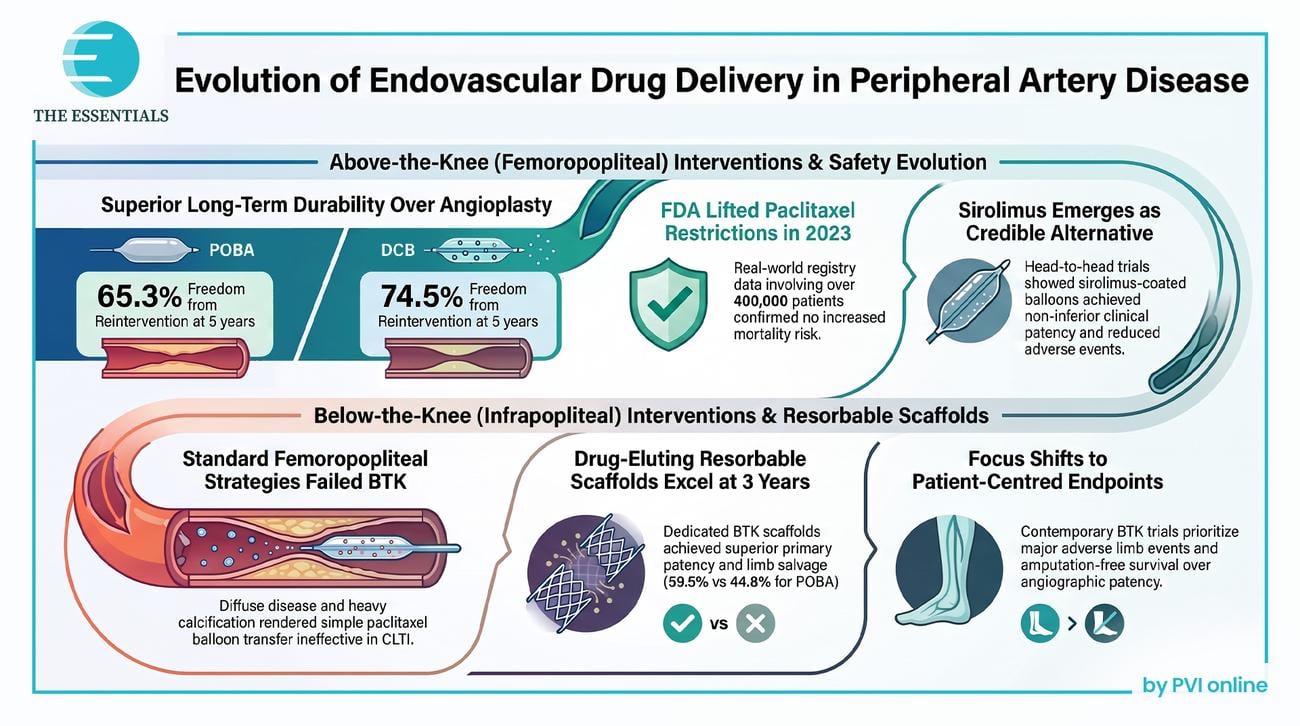
The early BTK experience exposed the limitations of simply transferring the femoropopliteal DCB paradigm to CLTI and BTK lesions. The BTK population is biologically and clinically different: smaller vessels, severe calcification, diffuse multilevel disease, diabetes, renal dysfunction and tissue loss create a substantially higher-risk environment. Most importantly, as demonstrated in BEST-CLI, the relevant endpoints in CLTI include freedom from major adverse limb events and death, rather than duplex-defined patency alone.31,32
IN.PACT DEEP, the largest RCT of paclitaxel-coated DCBs in BTK disease, not only failed to demonstrate superiority over POBA in patients with CLTI but also raised numerical concerns about major amputation at 12 months.33 BIOLUX P II similarly showed no patency benefit with a paclitaxel-coated DCB in BTK lesions.34 The ACOART-BTK trial provides important randomised evidence supporting the biological plausibility of drug-coated balloon delivery below the knee.35 It evaluated the paclitaxel-coated Litos balloon in 120 patients with BTK lesions and demonstrated a higher rate of freedom from all-cause death with the coated balloon than with POBA (Kaplan–Meier estimate 74.6% vs 57.2%; log-rank P = 0.04) and a lower rate of composite major adverse events (34.5% vs 56.1%; log-rank P = 0.013). There was also a trend towards a higher rate of freedom from CD-TLR (70.5% vs 53.7%; log-rank P = 0.058), with no significant difference in major amputation (5.2% vs 1.8%; log-rank P = 0.347).
The evidence supporting DESs in BTK disease largely originated from coronary drug-eluting stents adapted for the infrapopliteal circulation.36,37 Their relatively short available lengths inherently restricted their use to focal disease. In ACHILLES, balloon-expandable sirolimus-eluting stents reduced angiographic restenosis at 1 year (22.4% vs 41.9%) and improved patency (75.0% vs 57.1%) compared with balloon angioplasty, but did not significantly reduce death, repeat revascularisation or amputation. As mentioned above, in YUKON-BTK, the mean target lesion length was only 31 ± 9 mm, while the ACHILLES trial enrolled lesions with a mean length of 27 ± 21 mm. These data cannot readily be extrapolated to the diffuse, multisegment and frequently occlusive tibial disease encountered in contemporary CLTI. In addition, balloon-expandable metallic stents may be susceptible to deformation, compression and fracture.
Accordingly, the Global Vascular Guidelines, developed jointly by the ESVS, SVS and WFVS,38 identified POBA as a reasonable primary endovascular approach because the evidence remained insufficient to support other technologies. Under these guidelines, DESs were considered a bailout option after failed POBA for short (< 3 cm), infrapopliteal lesions. The 2024 ESC Guidelines reached a similar conclusion.39
The rationale for a dedicated drug-eluting resorbable scaffold emerged from the need to address all these mechanisms of failure: temporary mechanical support to overcome recoil and dissection, sustained antiproliferative drug delivery to inhibit neointimal hyperplasia, and subsequent resorption to avoid leaving a permanent metallic implant that could contribute to in-stent restenosis (ISR). The Esprit BTK everolimus-eluting resorbable scaffold (DRS; Abbott Vascular) became the first purpose-built, dedicated BTK device to demonstrate clear and durable superiority over POBA at multiple time points in a randomised trial specifically designed for infrapopliteal CLTI. The study included 261 patients, predominantly with tibial lesions averaging 44 mm in length and a reference vessel diameter of approximately 2.9 mm. Following the initial report of superiority at 1 year,40 the data continued to evolve, demonstrating sustained benefits at 241 and 3 years.42 The primary efficacy endpoint, a composite of primary patency and limb salvage, was achieved in 59.5% of patients treated with DRS versus 44.8% of those treated with POBA (HR 0.55; P = 0.0025). Binary restenosis remained less frequent in the DRS group (38% vs 49%), while limb salvage was high and comparable between groups (93.8% vs 95.7%) through 3 years.42
The Esprit BTK platform is also evolving to address the mismatch between lesion lengths studied in pivotal trials and the much longer lesions encountered in routine CLTI practice. The original LIFE-BTK device matrix included lengths of up to 38 mm. In August 2026, Abbott announced CE Mark approval in Europe for a 76-mm Esprit BTK scaffold. LIFE-BTK therefore represents an important transition from a predominantly bailout-based paradigm towards purpose-built technology combining primary drug delivery with temporary scaffolding.
An international, multidisciplinary consensus involving 35 experts in vascular surgery, interventional cardiology, interventional radiology and vascular medicine provides the first structured framework for DRS use in BTK interventions.43 Strong consensus supports DRS use in patients with Rutherford category 4–6 CLTI, vessel diameters ≥ 3 mm, lesions ≤ 60 mm, preserved distal runoff and adequate vessel preparation. Areas of persistent uncertainty include small-vessel disease (< 3 mm), long-segment lesions requiring multiple scaffolds, thrombotic disease and patients with impaired tolerance of antiplatelet therapy. These uncertainties highlight the evidence gaps that next-generation scaffold technologies and ongoing trials will need to address.
- Tepe G, Schnorr B, Albrecht T, Brechtel K, Claussen CD, Scheller B, et al. Angioplasty of femoral-popliteal arteries with drug-coated balloons: 5-year follow-up of the THUNDER trial. JACC Cardiovasc Interv. 2015 Jan;8(1 Pt A):102–8. doi:10.1016/j.jcin.2014.07.023 PubMed PMID: 25616822.
- Laird JA, Schneider PA, Jaff MR, Brodmann M, Zeller T, Metzger DC, et al. Long-Term Clinical Effectiveness of a Drug-Coated Balloon for the Treatment of Femoropopliteal Lesions. Circ Cardiovasc Interv. 2019 Jun;12(6):e007702. doi:10.1161/CIRCINTERVENTIONS.118.007702
- Rosenfield K, Jaff MR, White CJ, Rocha-Singh K, Mena-Hurtado C, Metzger DC, et al. Trial of a Paclitaxel-Coated Balloon for Femoropopliteal Artery Disease. N Engl J Med. 2015 Jul 9;373(2):145–53. doi:10.1056/NEJMoa1406235 PubMed PMID: 26106946.
- Krishnan P, Faries P, Niazi K, Sachar R, Jain A, Brodmann M, et al. Stellarex Drug-Coated Balloon for the Treatment of Peripheral Artery Disease: Five-Year Results from the ILLUMENATE Pivotal Randomized Controlled Trial. Am J Cardiol. 2024 Sep 15;227:83–90. doi:10.1016/j.amjcard.2024.06.027 PubMed PMID: 39019203.
- Sachar R, Soga Y, Lopez L, Kozuki A, Brodmann M, Ramanath VS, et al. Long-term results of the RANGER II SFA randomized trial of the Ranger drug-coated balloon vs standard percutaneous transluminal angioplasty for femoropopliteal artery treatment. Vasc Med. 2025 Oct;30(5):599–601. doi:10.1177/1358863X251349782 PubMed PMID: 40686033; PubMed Central PMCID: PMC12569101.
- Schneider PA, Laird JR, Tepe G, Brodmann M, Zeller T, Scheinert D, et al. Treatment Effect of Drug-Coated Balloons Is Durable to 3 Years in the Femoropopliteal Arteries: Long-Term Results of the IN.PACT SFA Randomized Trial. Circ Cardiovasc Interv. 2018 Jan;11(1):e005891. doi:10.1161/CIRCINTERVENTIONS.117.005891 PubMed PMID: 29326153; PubMed Central PMCID: PMC5771683.
- Teichgräber, U., Lehmann, T., Ingwersen, M. et al. Long-Term Effectiveness and Safety of Femoropopliteal Drug-Coated Balloon Angioplasty : 5-Year Results of the Randomized Controlled EffPac Trial. Cardiovasc Intervent Radiol 45, 1774–1783 (2022). https://doi.org/10.1007/s00270-022-03265-1
- Zeller T, Brodmann M, Ansel GM, Scheinert D, Choi D, Tepe G, et al. Paclitaxel-coated balloons for femoropopliteal peripheral arterial disease: final five-year results of the IN.PACT Global Study. EuroIntervention J Eur Collab Work Group Interv Cardiol Eur Soc Cardiol. 2022 Dec 2;18(11):e940–8. doi:10.4244/EIJ-D-21-01098 PubMed PMID: 35635160; PubMed Central PMCID: PMC9743239.
- Caradu C, Webster C, Nasr B, Sobocinski J, Louis N, Thévenin B, et al. Two-Year Outcomes of the French Multicentric Registry on LUMINOR Drug-Eluting Balloon for Superficial Femoral and Popliteal Arteries (LUMIFOLLOW). Ann Vasc Surg. 2025 Sep 15;S0890-5096(25)00615-6. doi:10.1016/j.avsg.2025.09.011 PubMed PMID: 40962112.
- Dake MD, Ansel GM, Jaff MR, Ohki T, Saxon RR, Smouse HB, et al. Durable Clinical Effectiveness With Paclitaxel-Eluting Stents in the Femoropopliteal Artery: 5-Year Results of the Zilver PTX Randomized Trial. Circulation. 2016 Apr 12;133(15):1472–83. doi:10.1161/CIRCULATIONAHA.115.016900 PubMed PMID: 26969758.
- Liistro F, Angioli P, Porto I, Ducci K, Falsini G, Ventoruzzo G, et al. Drug-Eluting Balloon Versus Drug-Eluting Stent for Complex Femoropopliteal Arterial Lesions: The DRASTICO Study. J Am Coll Cardiol. 2019 Jul 16;74(2):205–15. doi:10.1016/j.jacc.2019.04.057 PubMed PMID: 31296293.
- Bausback Y, Wittig T, Schmidt A, Zeller T, Bosiers M, Peeters P, et al. Drug-Eluting Stent Versus Drug-Coated Balloon Revascularization in Patients With Femoropopliteal Arterial Disease. J Am Coll Cardiol. 2019 Feb 19;73(6):667–79. doi:10.1016/j.jacc.2018.11.039 PubMed PMID: 30765033.
- Nakama T, Takahara M, Iwata Y, Suzuki K, Tobita K, Hayakawa N, et al. 3-Year Outcomes of Drug-Eluting Stent vs Drug-Coated Balloon for Femoropopliteal Artery Lesions: Propensity Score-Matched Real-World Study. JACC Cardiovasc Interv. 2025 Sep 8;18(17):2155–66. doi:10.1016/j.jcin.2025.07.034 PubMed PMID: 40930604.
- Cui HJ, Wu YF. The Efficacy of Drug-Coated Balloons and Drug-Eluting Stents in Infrapopliteal Revascularization: A Meta-analysis. J Endovasc Ther Off J Int Soc Endovasc Spec. 2025 Dec;32(6):1799–820. doi:10.1177/15266028231222385 PubMed PMID: 38183240.
- Iida O, Takahara M, Soga Y, Tomoi Y, Kawasaki D, Fujihara M, et al. Drug-Coated Balloon Versus Drug-Eluting Stent for Femoropopliteal Lesions: A 3-Year Propensity Score-Matched Analysis. Catheter Cardiovasc Interv. n/a(n/a). doi:10.1002/ccd.70750
- Katsanos K, Spiliopoulos S, Kitrou P, Krokidis M, Karnabatidis D. Risk of Death Following Application of Paclitaxel-Coated Balloons and Stents in the Femoropopliteal Artery of the Leg: A Systematic Review and Meta-Analysis of Randomized Controlled Trials. J Am Heart Assoc. 2018 Dec 18;7(24):e011245. doi:10.1161/JAHA.118.011245 PubMed PMID: 30561254; PubMed Central PMCID: PMC6405619.
- Kim JM, Li S, Song Y, Yeh RW, Secemsky EA. Dynamic Trends and Practice Patterns in Femoropopliteal Revascularization From 2016 Through 2023. J Am Coll Cardiol. 2025 Feb 18;85(6):645–8. doi:10.1016/j.jacc.2024.10.102 PubMed PMID: 39641733.
- Parikh SA, Schneider PA, Mullin CM, Rogers T, Gray WA. Mortality in randomised controlled trials using paclitaxel-coated devices for femoropopliteal interventional procedures: an updated patient-level meta-analysis. Lancet. 2023 Nov 18;402(10415):1848–56. doi:10.1016/S0140-6736(23)02189-X PubMed PMID: 37890499.
- Kim JM, Yeh RW, Song Y, Secemsky EA. Drug-coated vs non-drug-coated devices for femoropopliteal artery interventions: long-term outcomes of the SAFE-PAD study. Eur Heart J. 2026 May 5;47(17):2093–103. doi:10.1093/eurheartj/ehaf721 PubMed PMID: 40996087.
- Wargny M, Leux C, Chatellier G, Coudol S, Gourraud PA, Gouëffic Y. Mortality in a Nationwide Practice-Based Cohort Receiving Paclitaxel-Coated Devices for Lower Limb Peripheral Artery Disease. J Am Coll Cardiol. 2024 Apr 2;83(13):1207–21. doi:10.1016/j.jacc.2024.02.003 PubMed PMID: 38538200.
- Li Y, Chen S, Qian L, Zhao J, Xue T, Jia Z. Safety of paclitaxel-coated devices in patients with peripheral artery disease: an updated systematic review and meta-analysis of randomized controlled trials. eClinicalMedicine. 2026 Apr 10;94:103881. doi:10.1016/j.eclinm.2026.103881 PubMed PMID: 42011217; PubMed Central PMCID: PMC13091776.
- Katsanos K, Spiliopoulos S, Saratzis A, Teichgräber U, Zayed H, Kitrou P, et al. Editor’s Choice - Dynamic Risk of Death following Application of Paclitaxel Coated Devices in the Femoropopliteal Artery: A Contemporary Meta-analysis of Randomised Controlled Trials. Eur J Vasc Endovasc Surg Off J Eur Soc Vasc Surg. 2026 Jun;71(6):928–41. doi:10.1016/j.ejvs.2026.01.030 PubMed PMID: 41577117.
- Nordanstig J, James S, Andersson M, Andersson M, Delle M, Engström J, et al. Paclitaxel-coated versus uncoated devices for infrainguinal endovascular revascularisation in patients with intermittent claudication (SWEDEPAD 2): a multicentre, participant-masked, registry-based, randomised controlled trial. Lancet Lond Engl. 2025 Sep 13;406(10508):1115–27. doi:10.1016/S0140-6736(25)01584-3 PubMed PMID: 40902614.
- Nordanstig J, Hinchliffe R, Lejay A, Behrendt CA, Baumgartner I, Belch J, et al. Editor’s Choice – Focused Update on Paclitaxel Coated Technologies, from the 2024 European Society for Vascular Surgery (ESVS) Guidelines on the Management of Asymptomatic Peripheral Arterial Disease and Intermittent Claudication. Eur J Vasc Endovasc Surg. 2026 Jun 1;71(6):923–7. doi:10.1016/j.ejvs.2026.04.037 PubMed PMID: 42248619.
- Falkenberg M, James S, Andersson M, Andersson M, Delle M, Engström J, et al. Paclitaxel-coated versus uncoated devices for infrainguinal endovascular revascularisation in chronic limb-threatening ischaemia (SWEDEPAD 1): a multicentre, participant-masked, registry-based, randomised controlled trial. Lancet Lond Engl. 2025 Sep 13;406(10508):1103–14. doi:10.1016/S0140-6736(25)01585-5 PubMed PMID: 40902617.
- Bradbury AW, Hall JA, Popplewell MA, Meecham L, Bate GR, Kelly L, et al. Plain versus drug balloon and stenting in severe ischaemia of the leg (BASIL-3): open label, three arm, randomised, multicentre, phase 3 trial. BMJ. 2025 Feb 24;388:e080881. doi:10.1136/bmj-2024-080881 PubMed PMID: 39993822; PubMed Central PMCID: PMC11848676.
- Dubosq-Lebaz M, Li S, Gouëffic Y, Lee HH, Kim JM, Sobocinski J, et al. Safety and effectiveness of drug-coated devices in chronic limb-threatening ischaemia: a nationwide analysis. EuroIntervention J Eur Collab Work Group Interv Cardiol Eur Soc Cardiol. 2026 Mar 2;22(5):e313–25. doi:10.4244/EIJ-D-25-00769 PubMed PMID: 41770273; PubMed Central PMCID: PMC12927628.
- Gouëffic Y, Brodmann M, Deloose K, Dubosq-Lebaz M, Nordanstig J. Drug-eluting devices for lower limb peripheral arterial disease. EuroIntervention. 2024 Sep 16;20(18):e1136–53. doi:10.4244/EIJ-D-23-01080 PubMed PMID: 39279515; PubMed Central PMCID: PMC11423351.
- Teichgräber U, Ingwersen M, Lehmann T, Platzer S, Kunstmann I, Steiner S, et al. Comparison of Sirolimus- vs Paclitaxel-Coated Balloon Angioplasty for Femoropopliteal Artery Disease: The SIRONA Randomized Noninferiority Trial. J Am Coll Cardiol. 2026 Aug 25;88(8):780–96. doi:10.1016/j.jacc.2025.12.017 PubMed PMID: 41706076.
- Barco S, Engelberger RP, Held U, Fumagalli RM, Grigorean A, Hayoz D, et al. Sirolimus-Coated Balloon Angioplasty for Infrainguinal Artery Disease. N Engl J Med. 2026 Aug 6;395(6):561–70. doi:10.1056/NEJMoa2600360 PubMed PMID: 41911022.
- Farber A, Menard MT, Conte MS, Kaufman JA, Powell RJ, Choudhry NK, et al. Surgery or Endovascular Therapy for Chronic Limb-Threatening Ischemia. N Engl J Med. 2022 Dec 22;387(25):2305–16. doi:10.1056/NEJMoa2207899 PubMed PMID: 36342173.
- Butala NM, Chandra V, Beckman JA, Parikh SA, Lookstein R, Misra S, et al. Contextualizing the BEST-CLI Trial Results in Clinical Practice. J Soc Cardiovasc Angiogr Interv. 2023;2(4):101036. doi:10.1016/j.jscai.2023.101036 PubMed PMID: 37575528; PubMed Central PMCID: PMC10417884.
- Zeller T, Micari A, Scheinert D, Baumgartner I, Bosiers M, Vermassen FEG, et al. The IN.PACT DEEP Clinical Drug-Coated Balloon Trial: 5-Year Outcomes. JACC Cardiovasc Interv. 2020 Feb 24;13(4):431–43. doi:10.1016/j.jcin.2019.10.059 PubMed PMID: 32081236.
- Zeller T, Beschorner U, Pilger E, Bosiers M, Deloose K, Peeters P, et al. Paclitaxel-Coated Balloon in Infrapopliteal Arteries: 12-Month Results From the BIOLUX P-II Randomized Trial (BIOTRONIK’S-First in Man study of the Passeo-18 LUX drug releasing PTA Balloon Catheter vs. the uncoated Passeo-18 PTA balloon catheter in subjects requiring revascularization of infrapopliteal arteries). JACC Cardiovasc Interv. 2015 Oct;8(12):1614–22. doi:10.1016/j.jcin.2015.07.011 PubMed PMID: 26493253.
- Sun G, Liu J, Jia X, Xiong J, Ma X, Zhang H, et al. Long-term Outcomes of the AcoArt II-BTK Trial: Drug-Coated Balloon Angioplasty Compared With Uncoated Balloons for the Treatment of Infrapopliteal Artery Lesions. J Endovasc Ther Off J Int Soc Endovasc Spec. 2026 Jun;33(3):1430–8. doi:10.1177/15266028241304303 PubMed PMID: 39692034.
- Scheinert D, Katsanos K, Zeller T, Koppensteiner R, Commeau P, Bosiers M, et al. A Prospective Randomized Multicenter Comparison of Balloon Angioplasty and Infrapopliteal Stenting With the Sirolimus-Eluting Stent in Patients With Ischemic Peripheral Arterial Disease: 1-Year Results From the ACHILLES Trial. J Am Coll Cardiol. 2012 Dec 4;60(22):2290–5. doi:10.1016/j.jacc.2012.08.989
- Katsanos K, Spiliopoulos S, Diamantopoulos A, Siablis D, Karnabatidis D, Scheinert D. Wound Healing Outcomes and Health-Related Quality-of-Life Changes in the ACHILLES Trial: 1-Year Results From a Prospective Randomized Controlled Trial of Infrapopliteal Balloon Angioplasty Versus Sirolimus-Eluting Stenting in Patients With Ischemic Peripheral Arterial Disease. JACC Cardiovasc Interv. 2016 Feb 8;9(3):259–67. doi:10.1016/j.jcin.2015.10.038 PubMed PMID: 26777329.
- Conte MS, Bradbury AW, Kolh P, White JV, Dick F, Fitridge R, et al. Global Vascular Guidelines on the Management of Chronic Limb-Threatening Ischemia. Eur J Vasc Endovasc Surg Off J Eur Soc Vasc Surg. 2019;58(1S):S1-S109.e33. doi:10.1016/j.ejvs.2019.05.006 PubMed PMID: 31182334.
- Mazzolai L, Teixido-Tura G, Lanzi S, Boc V, Bossone E, Brodmann M, et al. 2024 ESC Guidelines for the management of peripheral arterial and aortic diseases. Eur Heart J. 2024 Sep 29;45(36):3538–700. doi:10.1093/eurheartj/ehae179 PubMed PMID: 39210722.
- Varcoe RL, DeRubertis BG, Kolluri R, Krishnan P, Metzger DC, Bonaca MP, et al. Drug-Eluting Resorbable Scaffold versus Angioplasty for Infrapopliteal Artery Disease. N Engl J Med. 2024 Jan 4;390(1):9–19. doi:10.1056/NEJMoa2305637 PubMed PMID: 37888915.
- DeRubertis BG, Varcoe RL, Krishnan P, Bonaca MP, O’Connor DJ, Pin R, et al. Drug-Eluting Resorbable Scaffold Versus Balloon Angioplasty for Below-the-Knee Peripheral Artery Disease: 2-Year Results From the LIFE-BTK Trial. Circulation. 2025 Oct 14;152(15):1076–86. doi:10.1161/CIRCULATIONAHA.125.075080 PubMed PMID: 40927852; PubMed Central PMCID: PMC12513053.
- Parikh SA, DeRubertis BG, Bonaca MP, Krishnan P, Pin RH, Lee JK, et al. Long-Term Outcomes of a Drug-Eluting Resorbable Scaffold vs Angioplasty in Infrapopliteal Chronic Limb-Threatening Ischemia: 3-Year Results From the LIFE-BTK Trial. J Am Coll Cardiol. 2026 Jul 7;88(1):95–109. doi:10.1016/j.jacc.2026.04.008 PubMed PMID: 42126372.
- Dubosq-Lebaz M, Schneider PA, Watson NW, Brodmann M, Rundback JH, Secemsky EA. Contemporary Indications for Bioresorbable Scaffolds for Infrapopliteal Peripheral Artery Disease: An International Expert Consensus. J Soc Cardiovasc Angiogr Interv. 2026 Jul;5(7):105458. doi:10.1016/j.jscai.2026.105458 PubMed PMID: 42502328; PubMed Central PMCID: PMC13400105.
This special report is available thanks to the support of iVascular.
PVI online develops independent educational programmes.

Get the latest clinical cases and breaking news delivered straight to your inbox!
