Economic impact and future directions: assessing value in peripheral revascularisation
 The value case for drug coated technology and the innovation pipeline shaping the next decade.
Explore the cost-effectiveness and budget impact of drug-coated technologies in PAD, examining clinical outcomes, healthcare costs and reimbursement policies, with a focus on CLTI and emerging treatment strategies.

The cost of healthcare is rising globally, placing increasing strain on healthcare systems and making the evaluation of the economic value of new treatments increasingly important. This is particularly relevant for emerging technologies in PAD, where higher acquisition costs may be justified only if they translate into meaningful improvements in clinical outcomes, reduced downstream healthcare utilisation, or both. The economic case for drug-coated technology is therefore more complex than the device price alone. Three distinct perspectives should be considered: cost-effectiveness, which evaluates the additional cost required to achieve an additional health benefit; budget impact, which assesses the financial consequences for a healthcare payer or system; and provider economics, which reflects the financial consequences for hospitals or physicians under a specific reimbursement structure. These perspectives may lead to different conclusions and should not be conflated. Furthermore, economic evaluations are strongly influenced by local device prices, reimbursement policies, healthcare utilisation, and the costs of reintervention and amputation, limiting their generalisability across healthcare systems.
Drug-eluting technologies have been used for more than two decades, and several cost-effectiveness analyses of both DCBs and DESs have been published. Early economic models generally assumed that the higher acquisition costs of drug-coated technologies would be offset by lower rates of restenosis and repeat revascularisation. However, this assumption requires careful interpretation because differences in patency and TLR observed during the first 1–2 years may attenuate with longer follow-up. Reduced restenosis and repeat revascularisation would compensate for higher acquisition costs A recent 2026 meta-analysis of randomised trials of paclitaxel-coated devices illustrates this issue: TLR was significantly reduced at 1 and 2 years, whereas the difference was no longer statistically significant at 5 years1. Economic models should therefore avoid simply extrapolating early differences in TLR or patency over a lifetime without testing the robustness of these assumptions.
The first study addressing the economic impact of DCBs evaluated their cost-effectiveness in Switzerland2. At 12 months, DCB treatment was associated with lower total inpatient treatment costs than POBA (SFr 861,916 vs SFr 951,877), despite the higher acquisition cost. Interestingly, because of dedicated reimbursement incentives for DCBs, their use was found to be the less financially favourable treatment approach from the physician/facility provider perspective, with a significant reduction in total earnings over 12 months. This example illustrates why reimbursement-driven provider economics should be distinguished from health-system cost-effectiveness.
In a study evaluating a urea-excipient DCB, the higher initial treatment costs were offset by lower target limb-related costs3. Total costs were similar at 2 years, with a trend towards greater quality-adjusted life-years (QALYs) in the DCB group. A modelling study evaluating endovascular interventions for superficial femoral artery disease in the UK and Germany showed that the incremental cost-effectiveness ratios (ICERs) for both DCBs and DESs were more favourable than those for POBA, with or without BMS4.
A decision model simulating patency at 1 and 2 years for POBA, BMS, DCBs, and DESs in a Medicare population demonstrated that, at 2 years, DCBs emerged as the most cost-effective initial treatment strategy, with the lowest overall costs and the highest modelled patency over the study horizon5. However, such findings should be interpreted in light of the model assumptions regarding the relationship between patency, TLR, and subsequent costs. Similarly, a comparison of BMS, DESs, DCBs, and POBA within the German public healthcare system and a Medicare population found that DCBs and DESs were associated with lower overall costs than BMS and POBA, largely because of lower probabilities of TLR6.
In a single-state US model based in Florida, with a 5-year time horizon, DES adoption instead of BMS was predicted to generate cost savings, provided that the incremental cost of DES over BMS remained below $677.597. Likewise, a French healthcare system-based analysis projected a net cumulative 5-year budget reduction of €6,807,202 for a population of 82,316 patients, including 21,361 patients treated with DESs8.
A budget impact analysis from Ontario, Canada, estimated annual savings of $470,000–640,000, based on the assumption that the use of DESs was associated with a lower risk of subsequent revascularisation9.
While most economic studies compared endovascular modalities, the randomised ZILVERPASS study also provides an important comparison with surgical bypass10. Its 3-year clinical and economic analysis, taking into account procedural, hospitalisation, and reintervention costs, demonstrated a clear cost benefit for DESs in both Germany and the US and confirmed that DESs can be considered a valid alternative to bypass surgery for long and complex femoropopliteal lesions.
Most of the studies discussed above evaluated populations with intermittent claudication. The economic implications may be substantially different in CLTI, where the costs associated with hospitalisation, prolonged wound care, infection, rehabilitation, major amputation, prosthetic provision, and loss of independence can substantially exceed those associated with the treatment of claudication. A pilot study co-sponsored by the CLI Global Society, evaluating the economic burden of CLTI in Germany, estimated total direct and indirect costs of approximately €9 billion, with an additional €1.6 billion attributable to the management of unhealed ulcers11. For this reason, economic evaluations in CLTI should not rely primarily on patency or TLR. More clinically meaningful endpoints include major amputation avoided, amputation-free survival, time to wound closure, wound-free days, hospital and rehabilitation days, the need for prosthetic care, maintenance of independent living, quality of life, and QALYs. A recent UK modelling and budget impact analysis based on national registry data estimated that reducing the proportion of major lower-limb amputations performed as the initial procedure for CLTI from 10% to 3% could generate net savings of approximately €9.6 million for the NHS12.
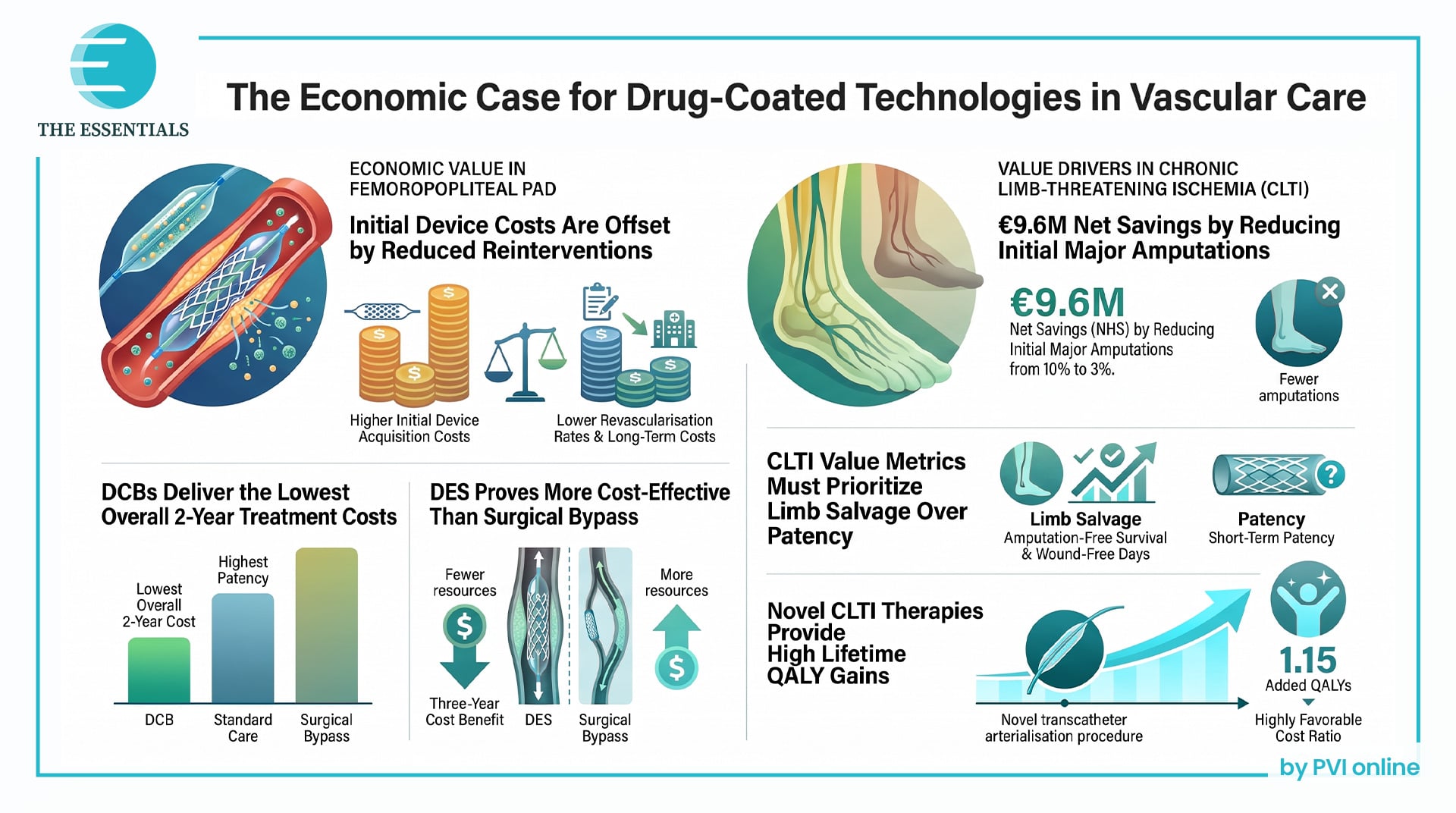
The economic evaluation of transcatheter arterialisation of the deep veins (TADV) provides an instructive example of how new technologies should be assessed in CLTI. In a recent analysis comparing TADV with conventional therapy in patients with no-option CLTI, TADV was associated with higher upfront costs but also with improved limb salvage, survival, and amputation-free survival at 1 year. Over a lifetime horizon, the model projected an additional 1.15 QALYs and 2.33 life-years, with an incremental cost of $24,738 and an ICER of approximately $21,600 per QALY gained13.
A subgroup analysis of the IN.PACT Global study specifically evaluating the cost-effectiveness of DCB use in the femoropopliteal segment in patients with CLTI showed that urea-excipient DCB therapy was associated with improved patient outcomes and expected overall cost savings for payers in the Dutch and German healthcare systems, resulting in a cost-effective and potentially dominant treatment strategy14. A large Medicare cohort of patients with CLTI compared three strategies: POBA with or without BMS, DCBs, and DESs15. Both DCBs and DESs were associated with reduced amputation and mortality rates, while DCBs appeared to provide clinical benefits without a corresponding increase in costs.
No cost-effectiveness studies evaluating DCB or DES use in the BTK segment have been identified in the literature, likely reflecting the historically limited evidence supporting these technologies in this anatomical territory.
The next generation of drug-coated technologies—including sirolimus-coated balloons and drug-eluting resorbable scaffolds—will therefore require economic evaluation alongside clinical efficacy. Prospective economic analyses should be embedded in randomised trials of new technologies, particularly in CLTI and below-the-knee disease.
- Li Y, Chen S, Qian L, Zhao J, Xue T, Jia Z. Safety of paclitaxel-coated devices in patients with peripheral artery disease: an updated systematic review and meta-analysis of randomized controlled trials. eClinicalMedicine. 2026 Apr 10;94:103881. doi:10.1016/j.eclinm.2026.103881 PubMed PMID: 42011217; PubMed Central PMCID: PMC13091776.
- Diehm N, Schneider H. Cost-effectiveness analysis of paclitaxel-coated balloons for endovascular therapy of femoropopliteal arterial obstructions. J Endovasc Ther Off J Int Soc Endovasc Spec. 2013 Dec;20(6):819–25. doi:10.1583/13-4416R.1 PubMed PMID: 24325699.
- Salisbury AC, Li H, Vilain KR, Jaff MR, Schneider PA, Laird JR, et al. Cost-Effectiveness of Endovascular Femoropopliteal Intervention Using Drug-Coated Balloons Versus Standard Percutaneous Transluminal Angioplasty: Results From the IN.PACT SFA II Trial. JACC Cardiovasc Interv. 2016 Nov 28;9(22):2343–52. doi:10.1016/j.jcin.2016.08.036 PubMed PMID: 27884360.
- Kearns BC, Michaels JA, Stevenson MD, Thomas SM. Cost-effectiveness analysis of enhancements to angioplasty for infrainguinal arterial disease. Br J Surg. 2013 Aug;100(9):1180–8. doi:10.1002/bjs.9195 PubMed PMID: 23842832.
- Sridharan ND, Boitet A, Smith K, Noorbakhsh K, Avgerinos E, Eslami MH, et al. Cost-effectiveness analysis of drug-coated therapies in the superficial femoral artery. J Vasc Surg. 2018 Jan;67(1):343–52. doi:10.1016/j.jvs.2017.06.112 PubMed PMID: 28958476; PubMed Central PMCID: PMC5741471.
- Pietzsch JB, Geisler BP, Garner AM, Zeller T, Jaff MR. Economic analysis of endovascular interventions for femoropopliteal arterial disease: a systematic review and budget impact model for the United States and Germany. Catheter Cardiovasc Interv Off J Soc Card Angiogr Interv. 2014 Oct 1;84(4):546–54. doi:10.1002/ccd.25536 PubMed PMID: 24782424.
- Sridharan ND, Liang N, Robinson D, Avgerinos E, Tzeng E, Makaroun MS, et al. Implementation of drug-eluting stents for the treatment of femoropopliteal disease provides significant cost-to-system savings in a single-state outpatient simulation. J Vasc Surg. 2018 Nov;68(5):1465–72. doi:10.1016/j.jvs.2018.02.040 PubMed PMID: 29779962; PubMed Central PMCID: PMC6394222.
- De Cock E, Sapoval M, Julia P, de Lissovoy G, Lopes S. A budget impact model for paclitaxel-eluting stent in femoropopliteal disease in France. Cardiovasc Intervent Radiol. 2013 Apr;36(2):362–70. doi:10.1007/s00270-012-0494-x PubMed PMID: 23073560; PubMed Central PMCID: PMC3595477.
- Health Quality Ontario. Paclitaxel Drug-Eluting Stents in Peripheral Arterial Disease: A Health Technology Assessment. Ont Health Technol Assess Ser. 2015;15(20):1–62. PubMed PMID: 26719778; PubMed Central PMCID: PMC4688325.
- Bosiers M, DE Donato G, Torsello G, Galvagni Silveira P, Deloose K, Scheinert D, et al. ZILVERPASS Study: ZILVER PTX Stent vs. Bypass Surgery in Femoropopliteal Lesions, 3 year results and economic analysis. J Cardiovasc Surg (Torino). 2023 Aug;64(4):413–21. doi:10.23736/S0021-9509.23.12607-3 PubMed PMID: 37162238.
- Tsotra F, Dolan F, Ubels J, Berg JC van den. EE331 Direct and Indirect Economic Burden Due to Chronic Limb-Threatening Ischemia (CLTI) in Germany. Value Health. 2025 Dec 1;28(12):S169. doi:10.1016/j.jval.2025.09.715
- Saratzis A, Zayed H, Buylova A, Rawlinson W, Veliu G, Siebert M. Economic impact of limb-salvage strategies in chronic limb-threatening ischaemia: modelling and budget impact study based on national registry data. BJS Open. 2024 Sep 3;8(5):zrae099. doi:10.1093/bjsopen/zrae099 PubMed PMID: 39291605; PubMed Central PMCID: PMC11408877.
- Powell RJ, Dua A, Clair DG, N’Dandu Z, Petruzzi NJ, Ryschon AM, et al. Clinical and economic outcomes of transcatheter arterialization of the deep veins in no-option chronic limb-threatening ischemia patients compared with conventional therapy. J Vasc Surg. 2026 Jun;83(6):1585-1594.e9. doi:10.1016/j.jvs.2026.01.016 PubMed PMID: 41610926.
- Pietzsch JB, Geisler BP, Iken AR, van Wijck IPS, Holewijn S, Reijnen MMPJ. Cost-Effectiveness of Urea Excipient-Based Drug-Coated Balloons for Chronic Limb-Threatening Ischemia from Femoropopliteal Disease in the Netherlands and Germany. Cardiovasc Intervent Radiol. 2022 Mar;45(3):298–305. doi:10.1007/s00270-021-03050-6 PubMed PMID: 34984489.
- Dubosq-Lebaz M, Li S, Gouëffic Y, Lee HH, Kim JM, Sobocinski J, et al. Safety and effectiveness of drug-coated devices in chronic limb-threatening ischaemia: a nationwide analysis. EuroIntervention J Eur Collab Work Group Interv Cardiol Eur Soc Cardiol. 2026 Mar 2;22(5):e313–25. doi:10.4244/EIJ-D-25-00769 PubMed PMID: 41770273; PubMed Central PMCID: PMC12927628.
This special report is available thanks to the support of iVascular.
PVI online develops independent educational programmes.

Get the latest clinical cases and breaking news delivered straight to your inbox!
