The evolution and clinical need for drug-coated technology
Why drug-coated platforms emerged: the mechanical era, its failures, and the tipping point that drove innovation.
 The evolution of peripheral arterial intervention reflects a shift from mechanical solutions to therapies targeting the biological response to vascular injury.
This exploration of drug-coated technologies examines the evidence shaping their use, and the challenges that remain in translating improved vessel patency into meaningful benefits for patients.


Peripheral arterial intervention has always existed at the intersection of mechanics and biology. The earliest endovascular therapies addressed the mechanical obstruction effectively but incompletely. Plain balloon angioplasty (POBA) can restore lumen and flow immediately, yet elastic recoil, flow-limiting dissection, negative remodelling, and neointimal hyperplasia may convert an apparently successful procedure into restenosis.
Bare-metal nitinol stents (BMS) addressed recoil and dissection, however, permanent scaffolding introduced its own limitations in the femoropopliteal segment, where long lesions, calcification, inadequate vessel preparation, and repetitive flexion, compression and torsion can promote stent fracture, in-stent restenosis (ISR), and late failure. For many patients, successful revascularisation therefore became the beginning of a cycle of restenosis, repeat intervention, additional metal implantation, and progressively more complex disease.
At the same time, coronary intervention was demonstrating that restenosis was not simply a mechanical problem. The development of drug-eluting stents (DESs) and drug-coated balloons (DCBs) represented a conceptual shift: local delivery of antiproliferative therapy could modify the biological response to vascular injury rather than relying on mechanical scaffolding alone. DCBs were particularly attractive because they allowed antiproliferative drug delivery without necessarily leaving a permanent implant behind.
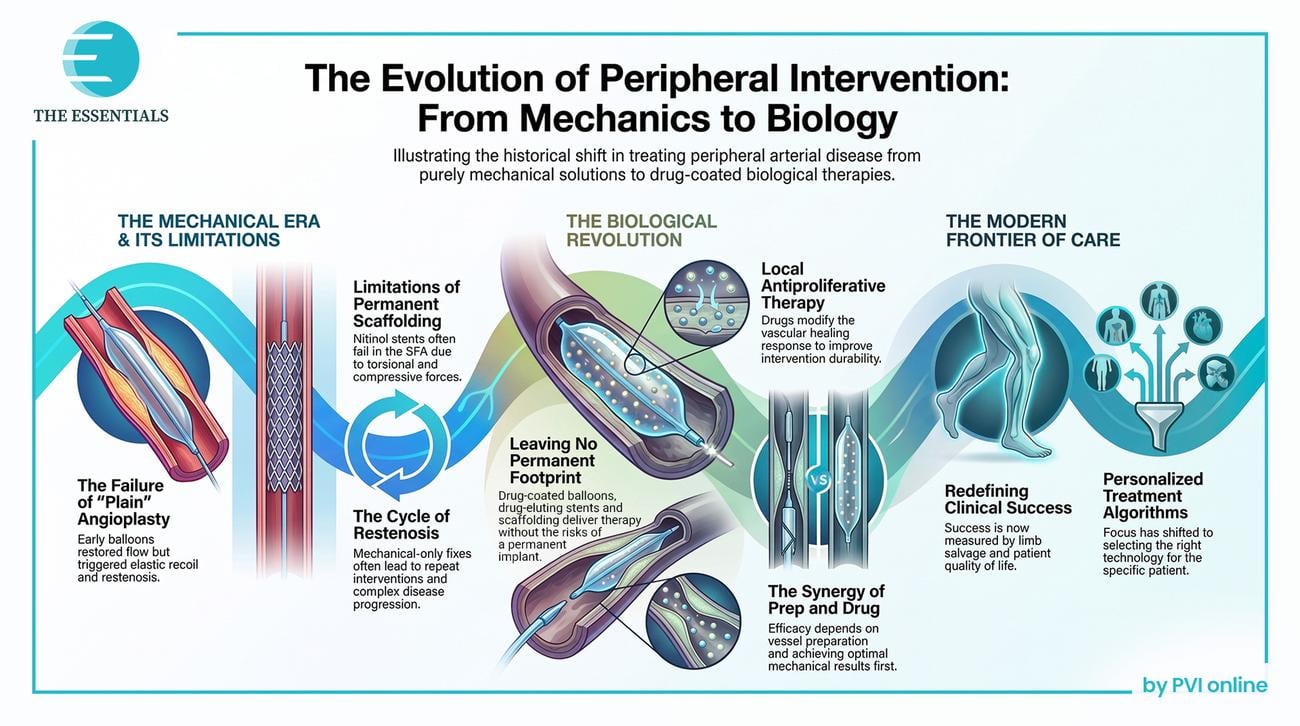
Two decades of clinical investigation have established that drug-coated technology can improve angiographic durability and reduce repeat intervention in selected femoropopliteal lesions. However, device efficacy depends on the ability to achieve an optimal mechanical result before expecting a biological therapy to maintain it. Likewise, paclitaxel, sirolimus, and everolimus should not be regarded as interchangeable merely because they are antiproliferative agents. Drug dose, excipient, tissue transfer, pharmacokinetics and delivery platform all influence therapeutic effect. More importantly, improved patency does not necessarily translate into improved walking capacity, wound healing, limb salvage, quality of life, or survival.
This distinction is increasingly important because femoropopliteal disease, infrapopliteal chronic limb threatening ischemia (CLTI), intermittent claudication and ISR represent different biological and clinical problems. The question is no longer simply whether drug-coated technology works. It is where it works, in whom it provides meaningful benefit, how it should be combined with contemporary vessel preparation and scaffolding strategies, and which outcomes should define success.
This issue examines that evolution, from the pivotal femoropopliteal trials and the paclitaxel controversy to resorbable scaffolds, sirolimus-based therapies, modern treatment algorithms, and health economics. The next chapter in drug coated therapy will be defined not merely by keeping arteries open, but by proving that better vascular durability translates into better lives for our patients. The contemporary era should therefore be understood not as a competition between DCB and DES, or between paclitaxel and limus-based technologies, but as a transition toward mechanism-specific, lesion-specific and patient-centred endovascular therapy.
This special report is available thanks to the support of iVascular.
PVI online develops independent educational programmes.

Get the latest clinical cases and breaking news delivered straight to your inbox!
